
Researchers in a 2024 study identified what factors were involved in fertilization failure and built a nomogram (calculator) to help predict when this happens, with moderate predictive ability.
🔗 Original studies are referenced in this post or within the linked Remembryo posts.
💡 Reminder: Terms underlined with a dotted black line are linked to glossary entries. Clicking these does not count toward your paywall limit.
Study details
This section covers key details of how the study was performed, including patient characteristics, how they were treated, and other methods used. For those who aren’t interested in these details, and just want to see the results, you can go ahead and skip this part.
- This was a retrospective study that took place at a single IVF clinic in China between 2015 and 2023.
- Insemination was done using a modified conventional IVF method, where eggs are sperm were incubated together for 4 hours instead of overnight. I was surprised to see this protocol, but based on this meta-analysis it has its benefits, albeit with a slight reduction in fertilization rate.
- After insemination, the eggs had their surrounding granulosa cells removed to make it easier to check for fertilization (by exclusion of the second polar body).
- Fertilization failure was defined as having less than 30% fertilization after insemination.
In terms of the sample size, there were 1,770 patients, with 14.9% experiencing fertilization failure (<30% fertilization).
Factors associated with fertilization failure
They identified a number of factors that were associated with fertilization failure. Included below are the odds ratios and 95% confidence intervals, to show the strength of the association.
- Years of infertility (1.063 [1.002-1.126])
- Oligoasthenozoospermia (sperm concentration < 15 million/ml, sperm motility < 40%) (1.512 [1.013-2.241])
- Sperm concentration (0.982 [0.971-0.993])
- Sperm viability % (1.177 [1.086-1.282])
- Progressive motility % (0.821 [0.751-0.894])
- Abnormal sperm % (1.312 [1.122-1.543])
- Basal estrogen on trigger day (0.991 [0.984-0.998])
- Number of eggs retrieved (0.939 [0.906-0.971])
- Mature egg rate % (0.106 [0.046-0.239])
Nomogram (calculator) for predicting fertilization failure
Based on the factors above, the researchers built a special type of calculator called a nomogram that you can see below.
To work with this, you need to add up the points for each factor and then put your total points on the bottom line to get the probability of fertilization failure. Keep scrolling and I’ll demonstrate this, but first some pointers:
- Rates are indicated as decimal points (so for a 50% egg maturity rate, it’s 0.5)
- The probability of fertilization failure can be <10% or >90%. For example, if your total points were 200, this would be <10% chance of fertilization failure.
- Remember, fertilization failure means the <30% fertilization in this study!
- For oligoasthenozoospermia, 0 means it doesn’t apply and 1 means it does.
- Sperm concentration is in millions.
- Sperm vitality = viability.
- Basal (baseline) estrogen levels are in pg/ml
- Teratozoospermia (normal morphology <4%) and progesterone on the day of hCG trigger are on the nomogram below, but they weren’t identified as being significant above. I think including these in the nomogram was a mistake so they shouldn’t be considered, and I’ve contacted the authors to see what they say (hopefully they respond).
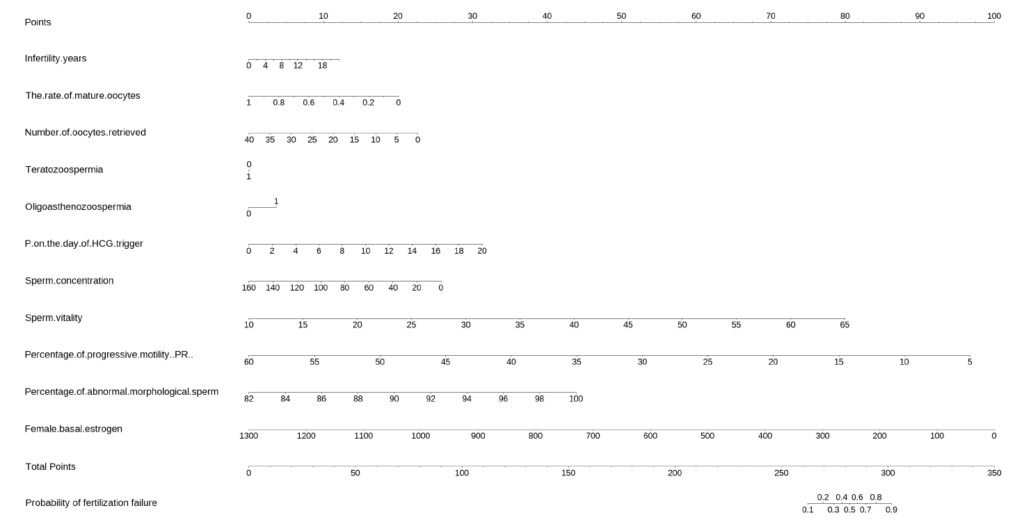
And below we can see an example of this in action! In this example, the patient has been infertile for 4 years, had a 60% of her retrieved eggs as mature, 10 eggs retrieved, without oligoasthenozoospermia, 40 million sperm/ml, 50% sperm viability, 10% progressive motility, 99% abnormal sperm and 800 pg/ml for basal estrogen levels.
This gives a total score of 272.5, or about a 20% chance of fertilization failure.

Now the researchers wanted to make sure it did a good job in predicting fertilization failure by testing their nomogram.
To do this, they did a ROC analysis. You can check the glossary for ROC, but it’s basically an analysis to see how well a test works, based on its AUC value.
This nomogram had an AUC value of 0.776, which means is has moderate predictive value for fertilization failure. The 0.776 is based on the training set. They got an AUC of 0.756 for the validation set.
Conclusions
This study found a number of factors that were associated with fertilization failure, including the years of infertility, sperm concentration, the number of eggs retrieved and more.
Based on these factors, the researchers constructed a nomogram that showed good predictive value for fertilization failure. Remember that fertilization failure in this study corresponds to <30% fertilization.
A limitation of this study is that it’s based on conventional IVF and not ICSI. It would be interesting to see if these same factors were involved in fertilization failure in patients performing ICSI. The authors also note that they should validate their model with external clinics to see if it’s generalizable.
Related studies
To learn more about this topic, you can check out a number of studies referenced in this study below (5 links):

Reference

About Embryoman
Embryoman (Sean Lauber) is a former embryologist and the founder of Remembryo, an IVF research and fertility education website. After working in an IVF lab in the US, he returned to Canada and now focuses on making fertility research more accessible. He holds a Master’s in Immunology and launched Remembryo in 2018 to help patients and professionals make sense of IVF research. Sean shares weekly study updates on Facebook, Instagram, and Reddit regularly. He also answers questions on Reddit or in his private Facebook group.
Related posts:
 Artificial oocyte activation improves IVF outcomes in clinical trial
 Abnormal fertilization and the potential of 0PN, 1PN and 3PN zygotes
 Study examines impact of changing ovarian stimulation protocol
 Sleep quality and its impact on IVF outcomes
 Can sperm and egg be “genetically incompatible”?
 An Italian consensus on key performance indicators for assessing IVF clinics
 First report of a healthy birth from an “abnormally fertilized” 4PN embryo
 Abnormal embryo cleavage