
Here’s your IVF research roundup for November 2025. Each month, I highlight everything I’ve shared on Remembryo — including new IVF study summaries, popular social posts, answers to community questions, and a full list of research highlights with links and short summaries from my newsletter. The paywall is off for this post.
📬 Like this roundup?
Get IVF research summaries, news highlights, and weekly subscriber-only content straight to your inbox.
Subscribe to the Remembryo Newsletter →
🔗 Original studies are referenced in this post or within the linked Remembryo posts.
💡 Reminder: Terms underlined with a dotted black line are linked to glossary entries. Clicking these does not count toward your paywall limit.
Remembryo posts
Here’s what I covered this month on Remembryo. Click any image to read more.
A 2025 study found that aging eggs and their support cells may have increased ribosome activity that contributes to reduced egg quality, and early clinical results suggest that rapamycin may help improve embryo quality and pregnancy rates. Read more.
A small 2025 study found that most pregnancies show detectable hCG by day 6 after a blastocyst transfer, and those that first become positive on day 8–10 have higher rates of biochemical and ectopic pregnancy and a lower chance of ongoing pregnancy. Read more.
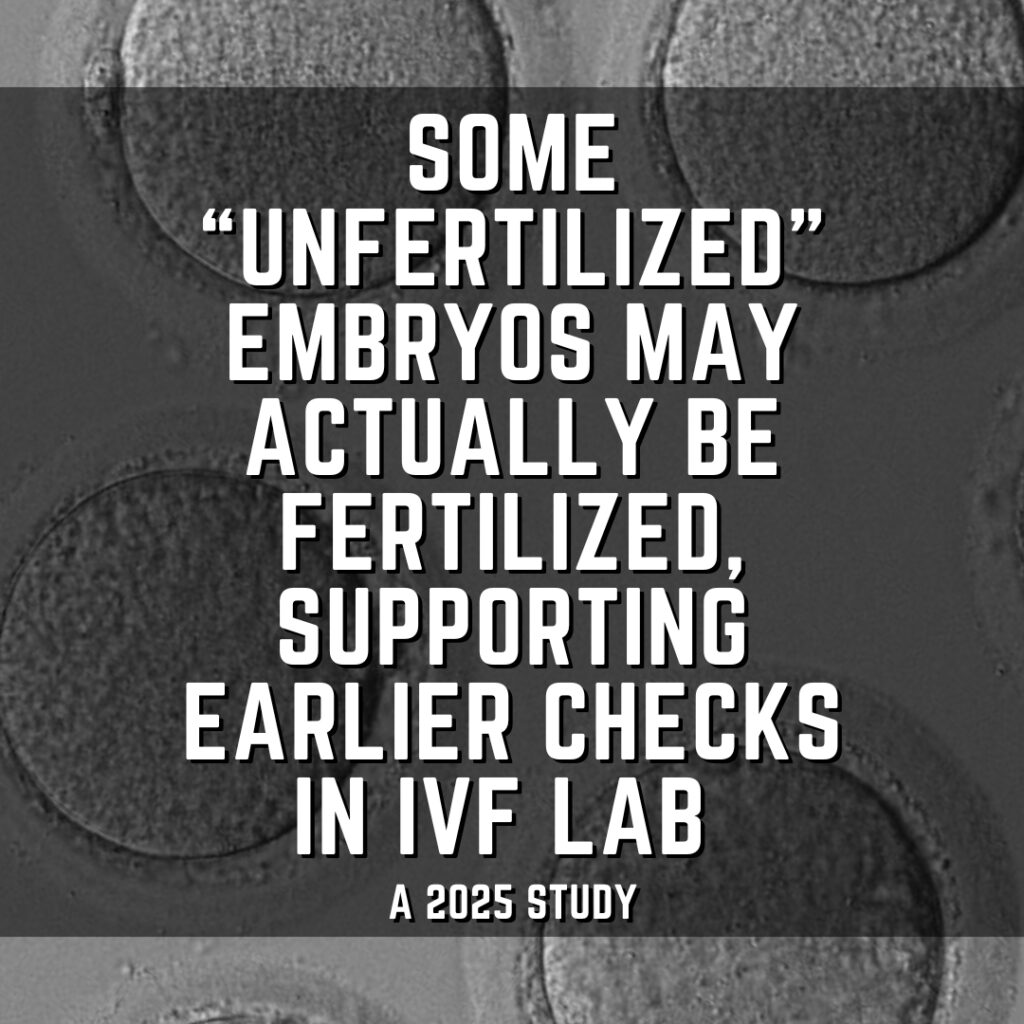
A 2025 study found that 0PN zygotes can actually be normally fertilized but missed during the standard 16–18 hour fertilization check, while those that never form pronuclei are likely unfertilized eggs, supporting a slightly earlier check around 16–17 hours and continued culture of 0PNs to the blastocyst stage for confirmation of fertilization. Read more.
In a 2025 study, researchers found that poor mitochondrial activity limits the ability of immature eggs to reach maturity, leading to reduced maturation in eggs from older women. Read more.
A 2025 meta-analysis combined the results of 22 studies and found no clear improvement in live birth rates from hormonal add-on for poor ovarian response, though growth hormone and testosterone ranked as the most promising options, and growth hormone increased the number of eggs retrieved. Read more.
A 2025 study showed that supplement use is widespread among IVF patients, with mixed impressions, limited evidence, and frequent confusion that leads many people to seek guidance from online communities rather than from clinical recommendations. Read more.
A 2025 case report shows that some ICSI-derived 3PN embryos can be rescued by removing the extra female pronucleus, resulting in a healthy live birth, but the technique remains experimental. Read more.
Top viewed posts on social
Here you can see the top 3 most popular posts for the month on Instagram, excluding the posts from above.
- New study suggests women with PCOS may maintain fertility longer. AMH usually falls with age, but a study found that women with PCOS lost AMH more slowly, kept higher levels after 36, and produced more oocytes, more fertilized eggs, and more usable blastocysts per retrieval than women without PCOS. Their cumulative pregnancy rates after IVF remained steady as they aged, while outcomes declined in the non PCOS group. Read the full study in Human Reproduction Open.
- Laboratory model provides insight into why euploid embryos might fail after transfer. A study grew euploid blastocysts to day 11 and used their ability to attach to the culture dish as a model for implantation, then analyzed gene activity in the trophectoderm. Embryos that failed to attach showed lower expression of genes tied to mitochondrial function and higher activity in immune and stress related pathways, hinting at possible future tools to assess implantation potential. Read the full study in F&S Science.
- Study links health diet to faster embryo development — but not higher IVF success. A new study using time lapse imaging found that parents who ate a healthy diet rich in fruits, vegetables, nuts, and fish had embryos that developed slightly faster and scored higher on timing based quality measures, while snack and alcohol heavy diets were linked to slower development. These differences did not translate into higher pregnancy or live birth rates, and the authors note that larger studies are needed to determine whether diet related improvements in early embryo development meaningfully affect IVF success. Read the full study in the Journal of Assisted Reproduction and Genetics.
And here’s the top 3 older Remembryo posts (based on Instagram story views). Click any image to read more.
A 2024 study compared IVF outcomes and pregnancy rates for patients of different ages (<32 to >40) who had their first single embryo transfer. Read more.

Researchers in 2024 report on live births after segmental aneuploid transfers, finding that they have similar rates as high level mosaic segmental aneuploids. Read more.

Researchers in a 2024 study compared the costs of patients with or without PGT-A, finding that patients younger than 35 may not benefit because of the higher chance of top-graded embryos being euploid anyway. Read more.
IVF in the news highlights
Each week in the Remembryo newsletter, I share short summaries of IVF-related stories that made headlines. Below are 5 leading headlines for the month, with the first two summarized:
- Surge in C-sections linked to deadly placenta condition. Placenta accreta, a dangerous condition where the placenta grows into C-section scar tissue, is becoming far more common as cesarean rates rise, now affecting as many as 1 in 272 births. The complication can cause massive bleeding and maternal death, leading doctors to warn that unnecessary C-sections are driving preventable tragedies and straining hospitals unprepared for such high-risk cases. Read more on The New York Times.
- Large study finds birth control safe despite social media scare posts. A large Swedish study of more than two million girls and women found that hormonal birth control is safe overall, with only a small and temporary rise in breast cancer diagnoses while someone is currently using it. Doctors say the actual increase is very small in real numbers and warn that social media often exaggerates these findings and leaves out key context. Read more on KFF Health News.
- U.S. gets D+ again for preterm birth rate. Read more on Axios.
- New guidance pushes wider use of aspirin to lower preeclampsia risk. Read more on NBC News.
- Study finds higher weight gain, pregnancy risks after stopping GLP-1 drugs. Read more on The Washington Post.
💡 Enjoying this summary?
Join 10,000+ readers who stay updated on IVF research each week:
Sign up here →
IVF questions from the community
Here are select questions that I answered either in my Facebook group or on Reddit.
- How many of my blastocysts will be euploid? The biggest predictor for euploidy is age. In a study of more than 86,000 biopsied blastocysts, euploid rates start high and fall steadily each year after the mid-30s. Patients under 35 had the highest chance of a chromosomally normal embryo, with about 58% of blastocysts testing euploid. That drops to 51% at ages 35–37, 41% at ages 38–40, 27% at ages 41–42, and 16% after 42. At the same time, aneuploid embryos rise sharply with age, reaching more than 60% in the oldest group. Read more in my post A look at how PGT-A results change with age, using data from over 86,000 biopsies.
- Is a medicated FET better than a natural FET? For women who ovulate regularly, recent evidence suggests the opposite: natural cycle FETs might perform better than medicated FETs. A large 2025 randomized controlled trial found that natural cycle FETs led to higher live birth rates (about 54% vs 43%) and lower miscarriage rates than medicated cycles. The main difference is that natural cycles create a corpus luteum after ovulation, which produces key hormones like progesterone, relaxin, and VEGF that help the lining mature and improve blood flow. Medicated cycles replace these hormones with pills or injections, but they don’t perfectly mimic the natural hormonal environment. However, a recent Cochrane review found no clear evidence that any FET preparation protocol (natural, modified natural, or fully medicated) was superior overall, highlighting the need for more studies. Read more in my post Live birth rates higher with natural cycle FETs vs medicated FETs.
- Does long-term storage of embryos reduce the success rate? A large 2024 study that analyzed more than 58,000 thawed blastocysts found no difference in live birth rates or thaw survival for embryos stored for up to 10 years, even after adjusting for factors like age, embryo quality, diagnosis, and endometrial protocol. This aligns with a recent meta-analysis showing no drop in outcomes with longer storage. Read more in my post Study finds no difference in live birth rates for embryos frozen up to 10 years.
IVF research brief
🔒 The full research brief for the month begins below (paid subscribers only)
Each week I flag ~20 IVF studies I find most helpful. Some are covered in detail on Remembryo, but paying subscribers get short summaries and links to all of them, organized into categories like implantation, egg quality, PGT-A, etc.
Below is the full list of 71 short summaries and links for studies that weren’t featured on Remembryo (available to paying members only).
🔍 Sneak peek: 3 select summaries from the month
- This multicenter retrospective cohort study of over 37,000 singleton live births found that women with unexplained recurrent implantation failure had higher risks of placenta previa, placental abruption, Cesarean delivery, and preterm birth, though the absolute increases were small. Read more (full article)
- This retrospective observational study found that higher plasma levels of several PFAS chemicals (“forever chemicals”) were linked to fewer retrieved oocytes, lower fertilization and embryo development metrics, and reduced pregnancy rates in women undergoing IVF or ICSI. Read more (abstract only)
- This retrospective cohort study of 8155 first single euploid frozen embryo transfers found that patients living in more socioeconomically disadvantaged neighborhoods had progressively lower live birth rates and higher pregnancy loss, even after adjusting for clinical factors. Read more (abstract only)
If you like these, consider subscribing below to get the full list.


About Embryoman
Embryoman (Sean Lauber) is a former embryologist and the founder of Remembryo, an IVF research and fertility education website. After working in an IVF lab in the US, he returned to Canada and now focuses on making fertility research more accessible. He holds a Master’s in Immunology and launched Remembryo in 2018 to help patients and professionals make sense of IVF research. Sean shares weekly study updates on Facebook, Instagram, and Reddit regularly. He also answers questions on Reddit or in his private Facebook group.