

Researchers in a 2019 study compared PGT-A outcomes for good/fair quality vs poor quality embryos, finding that poor quality euploids have a reduced live birth rate and increased miscarriage rate.
In Italy, the law 40/2004 requires that clinics do not dispose of embryos unless they show CLEAR SIGNS of degradation or arrest.
Cimadomo et al. (2019) used this unique situation to their advantage. In their paper they compared euploids that were either good/fair quality to poor quality. Poor quality embryos had a quality that was less than a BB, so a CB, BC or CC.
Check my complete guide to PGT-A to get more background on PGT-A (aka PGS testing).
🔗 Original studies are referenced in this post or within the linked Remembryo posts.
💡 Reminder: Terms underlined with a dotted black line are linked to glossary entries. Clicking these does not count toward your paywall limit.
This study looked at over 2500 PGT-A cycles over a 5 year period and found that in about half of these cycles there was at least 1 poor quality embryo, and in about 10% of these cycles all they had were poor quality embryos!
All in all, this amounted to about 1500 poor quality embryos. That’s a lot of embryos that wouldn’t make the cut in most clinics! So how did these embryos do?
- 23.5% were euploid compared to 51.0% for good/fair quality blasts
- 10.9% of poor quality euploids led to a live birth (vs 44.8%)
- 36.4% resulted in a miscarriage (vs 13.9%)
They also looked at how age fits into all this.
They found that older women (>42) are about twice as likely to produce poor quality embryos compared to younger women (<35). For someone in their mid 40’s they might expect about 1/3 of their embryos to be poor quality!
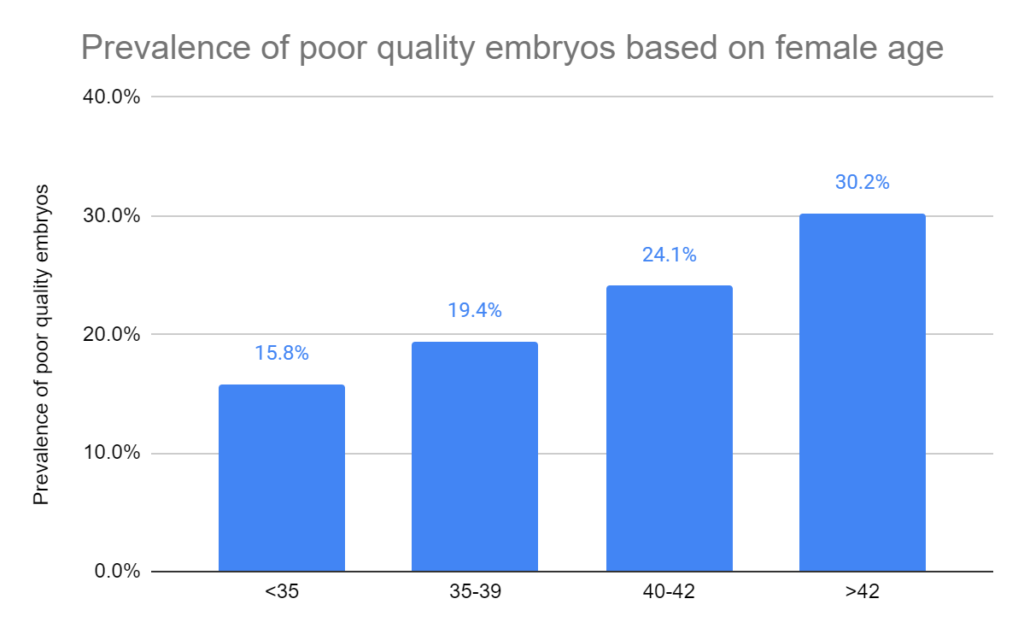
And since many clinics have quality standards for what makes the cut for PGT-A – this could be a problem for older women.
By including poor quality euploid embryos along with the good/fair embryos, these researchers found that the overall live birth rate increased 5.2% in women >42 and 2.5% for women <35. This was based on the live birth rate of cycles that involved only good/fair quality embryos compared to cycles that also included poor quality embryos.
Overall, the success rates with poor quality euploids aren’t incredible, but we need to remember the point of all this is to make babies. Out of 193 women who transferred poor quality euploids, 21 had a baby, and 12 miscarried. I can guarantee those 21 women are glad their clinic transferred poor quality embryos!
Reference

About Embryoman
Embryoman (Sean Lauber) is a former embryologist and the founder of Remembryo, an IVF research and fertility education website. After working in an IVF lab in the US, he returned to Canada and now focuses on making fertility research more accessible. He holds a Master’s in Immunology and launched Remembryo in 2018 to help patients and professionals make sense of IVF research. Sean shares weekly study updates on Facebook, Instagram, and Reddit regularly. He also answers questions on Reddit or in his private Facebook group.