
Researchers in a 2026 study found that natural FETs using donor eggs were linked to higher live birth rates, lower miscarriage rates, and lower rates of some pregnancy complications compared to medicated FETs.
For a frozen embryo transfer (FET), the uterine lining must be prepared to support implantation. This can be done with a natural FET that follows the body’s own hormones, or a medicated FET that uses estrogen and progesterone to prepare the lining and schedule the transfer.
Both approaches are common, but it isn’t clear which leads to better outcomes. Some studies suggest medicated FETs may be linked to higher risks of miscarriage and pregnancy complications, possibly because there is no corpus luteum, which normally produces important hormones during natural cycles.
To better focus on the effect of the transfer protocol itself, Rafael et al. (2026) looked only at donor egg cycles. Donor eggs were used to help control for egg quality differences, which can strongly affect IVF success rates and make these comparisons harder to interpret. The researchers also looked at whether age changed the outcomes, since natural FETs are less common in older women because of concerns over age-related hormonal changes.
For more background, check out my post Comparing frozen embryo transfer/FET protocols.
🔗 Original studies are referenced in this post or within the linked Remembryo posts.
💡 Reminder: Terms underlined with a dotted black line are linked to glossary entries. Clicking these does not count toward your paywall limit.
Study details
- Study type: Retrospective multicenter cohort study conducted between 2010 and 2023 at clinics in Spain and Portugal.
- Participants: 67,048 donor egg frozen embryo transfers in women aged 18–49 years (6922 had a natural FET, 60,126 had a medicated FET; average age about 42). No PGT, no women with untreated uterine/tubal abnormalities, and fresh or frozen donor eggs could be used.
- Embryo transfer: Single day 5 or day 6 blastocyst FETs.
- Primary outcome: Live birth rate.
- Statistical adjustment: In their analysis, confounders like age, BMI, embryo quality, infertility diagnosis, donor age, and transfer year were adjusted for.
Natural FETs were linked to higher live birth rates and lower miscarriage rates
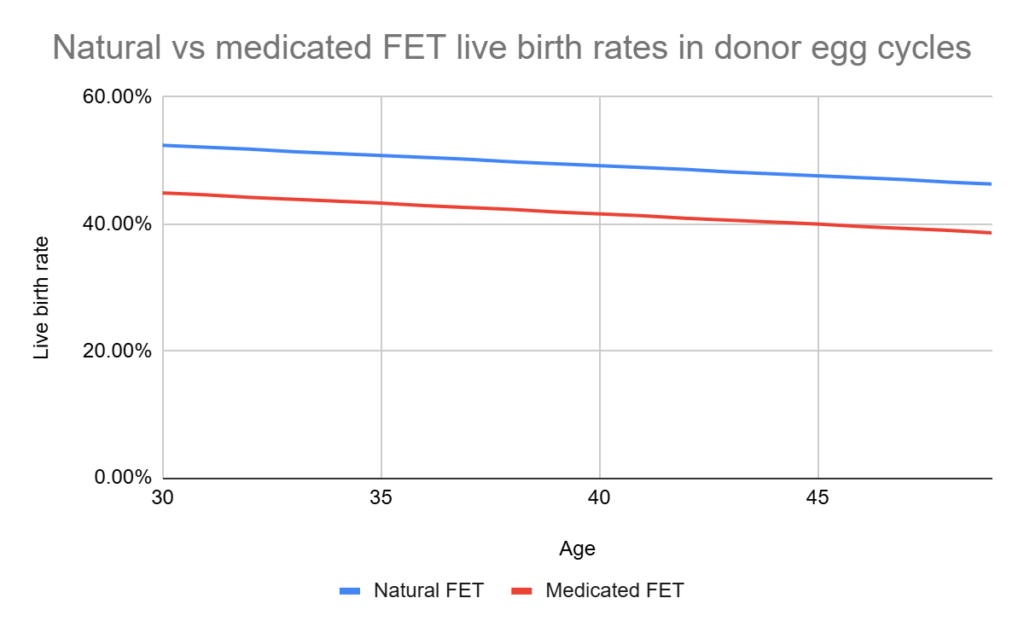
The researchers found that natural FETs were linked to higher pregnancy rates, higher live birth rates, and lower miscarriage rates compared to medicated FETs.
- Higher live birth rates (adjusted odds ratio [95% CI]: 1.38 [1.29–1.47]), meaning natural FETs had 1.38-times higher odds of live birth compared to medicated FETs
- Higher clinical pregnancy rates (adjusted odds ratio [95% CI]: 1.24 [1.16–1.32])
- Lower miscarriage rates (adjusted odds ratio [95% CI]: 0.68 [0.61–0.76])
The above data is based on all transfers, and the researchers also separated the data into first transfers and subsequent transfers. This is important because some patients had more than one embryo transfer, and success rates might change in patients with a history of failed transfers. They found similar results in all groups.
The researchers also looked at whether age changed the results. Some doctors prefer medicated FETs in older patients because of concerns that natural FETs may become less effective with age-related hormone changes. However, natural FETs appeared to have better outcomes across ages, and the researchers didn’t find strong evidence that age changed the relationship between transfer type and live birth rates (p= 0.08).
Natural FETs were linked to lower rates of some pregnancy complications
The researchers also looked at pregnancy and newborn outcomes after singleton live births. Compared to medicated FETs, natural FETs were linked to lower rates of several pregnancy complications:
- Lower rates of hypertensive disorders of pregnancy (adjusted odds ratio [95% CI]: 0.72 [0.56–0.94]), meaning natural FETs had 28% lower odds of hypertensive disorders compared to medicated FETs
- Lower Caesarean section rates (adjusted odds ratio [95% CI]: 0.86 [0.77–0.96])
- Lower rates of babies being large for gestational age (adjusted odds ratio [95% CI]: 0.77 [0.67–0.89])
The researchers found no differences in:
- Preterm birth
- Small for gestational age babies
- Birthweight
- Gestational diabetes
- Length of pregnancy
Natural FETs still had better outcomes even with rescue progesterone
Some clinics monitor progesterone levels around the time of transfer and give extra progesterone (“rescue” progesterone) if levels are low, especially in medicated FETs. To see whether this affected the results, the researchers separately analyzed 38,871 transfers where progesterone levels were monitored and rescue progesterone was given when needed, for both natural and medicated FETs.
Even in this subgroup, natural FETs were still linked to:
- Higher clinical pregnancy rates (adjusted odds ratio [95% CI]: 1.28 [1.18–1.38])
- Higher live birth rates (adjusted odds ratio [95% CI]: 1.42 [1.31–1.54])
- Lower miscarriage rates (adjusted odds ratio [95% CI]: 0.65 [0.57–0.74])
This suggests natural FETs still outperformed medicated FETs even after medicated cycles are optimized to correct for low progesterone.
Conclusion
This study found that natural FETs were linked to higher live birth rates, lower miscarriage rates, and lower rates of some pregnancy complications compared to medicated FETs. One major strength of this study is that it only included donor egg cycles, which helps reduce the effect of differences in egg quality that can vary with age.
The researchers also found that age didn’t appear to change the results. This is important because some clinics have age restrictions on natural FETs due to concerns that age-related hormonal changes could make them less effective. However, this study suggests natural FETs may still be a reasonable option in older patients.
The researchers also found that natural FETs still performed better even when medicated cycles used progesterone monitoring and “rescue” progesterone to correct low levels.
These results also fit with previous studies and meta-analyses showing that natural FETs are often linked to fewer pregnancy complications and, in some studies, lower miscarriage rates and improved live birth rates.
One possible explanation is the corpus luteum, which is present in natural FETs but absent in medicated FETs. The corpus luteum produces hormones and signaling molecules like progesterone, relaxin, and VEGF that can help support implantation, placental development, and blood vessel changes during early pregnancy.
Overall, this study adds to growing evidence that natural FETs may provide a more beneficial environment for implantation and pregnancy, while also reducing complications.
Limitations include the retrospective study design, possible differences between the groups that were not fully accounted for, and the relatively low number of natural FETs. Patients with more regular cycles were more frequent in the natural FET group (about 4% vs 10%), which the authors note could have affected the results, although this reflects real practice. Additionally, donor egg pregnancies are known to carry higher risks of complications like preeclampsia, so the results may not fully apply to IVF cycles using a patient’s own eggs (van Bentem et al. 2026).
Want to read more about natural FETs?

Researchers in a 2023 study found decreased adverse pregnancy and neonatal outcomes in those who performed a natural vs medicated FET, including abnormal birth weights, preeclampsia, preterm births, and more. Read more.
A 2025 randomized controlled trial found that natural cycle FETs led to higher live birth rates and fewer miscarriages than medicated FETs in ovulatory women with a good prognosis. Read more.
A 2026 randomized trial found that natural FETs had similar healthy live birth rates to medicated FETs, but were linked to lower risks of preeclampsia, pregnancy loss, and some other pregnancy complications. Read more.
A 2026 meta-analysis explored ways to optimize natural FETs, examining ovulation timing, progesterone use, luteinized unruptured follicles, and cycle variability across natural, modified natural, and newer natural proliferative phase approaches. Read more.
Reference
Filipa Rafael, Beatriz Nunes David, Juan Manuel Mascarós, Ana Neves, Elena Labarta, Nicolas Garrido, Sofia Nunes, Juan A Garcia-Velasco, Sérgio Reis-Soares, Samuel Santos-Ribeiro, Live birth rates after natural cycle versus artificial cycle in women receiving donated oocytes and the impact of female age, Human Reproduction, 2026;, deag058, https://doi.org/10.1093/humrep/deag058

About Embryoman
Embryoman (Sean Lauber) is a former embryologist and the founder of Remembryo, an IVF research and fertility education website. After working in an IVF lab in the US, he returned to Canada and now focuses on making fertility research more accessible. He holds a Master’s in Immunology and launched Remembryo in 2018 to help patients and professionals make sense of IVF research. Sean shares weekly study updates on Facebook, Instagram, and Reddit regularly. He also answers questions on Reddit or in his private Facebook group.