
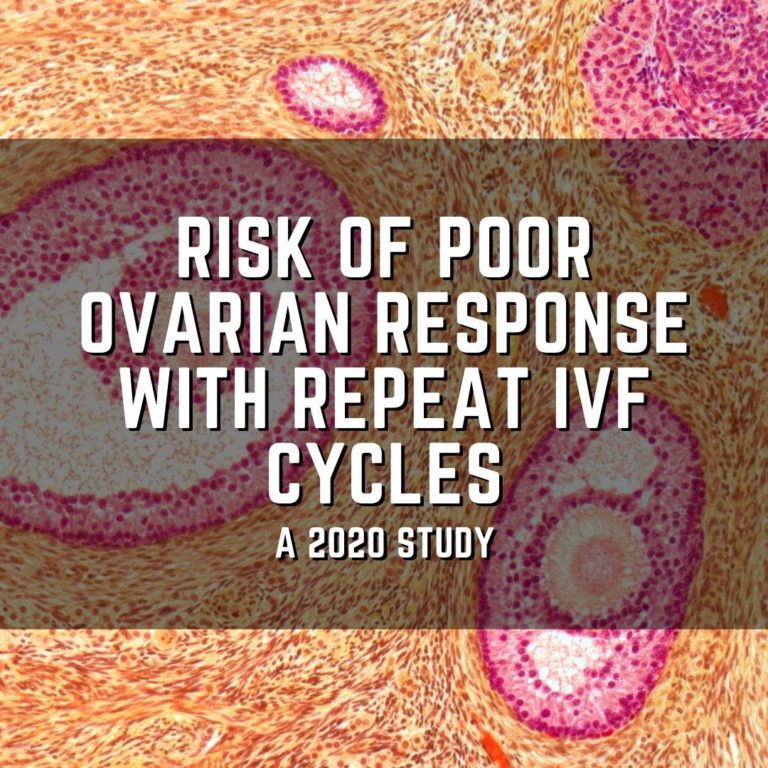
Researchers in a 2020 study examined the chance of having a poor ovarian response (POR, 3 or less eggs retrieved) based on age and AMH, and the chance of having a repeated POR in subsequent cycles.
Women with POR can be defined as having at least 2 of the 3 criteria (Ferraretti and Gianaroli 2014):
- Advanced age (>40)
- Previous poor ovarian response (cycles canceled or <3 eggs retrieved)
- Diminished ovarian reserve (<5 antral follicle count, <1 ng/ml AMH)
If two of these criteria aren’t met, having two previous episodes of POR (where <3 eggs were retrieved, or cycles canceled) would qualify as a poor responder.
Ovarian response is thought to decrease with advancing age. This is because the “ovarian follicle pool”, or ovarian reserve, decreases over the years. This follicle pool is used to recruit follicles for ovulation and over years and years of menstrual cycles, it begins to get smaller. You can read more about that here. AMH is a hormone that’s used to measure the size of this follicle pool. The number of antral follicles can also be used.
Women with POR are typically given higher doses of gonadotropins in order to maximize the number of eggs retrieved. Despite this, the chances of live birth are lower than normal or high responders.
A study by Papathanasiou and Mawal (2020) wanted to see if there was an increased risk of POR in a second IVF cycle, and what factors contributed to those risks.
Study details
This was a retrospective study that took place at a single IVF center between 2014 and 2020.
Women who had two successive IVF stimulations were included.
Women were excluded from this study if they didn’t have an AMH ovarian reserve test done within 2 months before their first IVF cycle.
Ovarian reserve was classified as follows:
- Low ovarian reserve = AMH of <5.4 pmol/L (0.8 ng/ml)
- Normal ovarian reserve = AMH of 5.4-25 pmol/L (0.8-3.5 ng/ml)
- High ovarian reserve = AMH of >25 pmol/L (3.5 ng/ml)
Ovarian response was classified as follows:
- Low ovarian response aka POR = 3 or less eggs retrieved
- Suboptimal ovarian response = 4-9 eggs retrieved
- Normal ovarian response = 10-15 eggs retrieved
Results
A total of 1224 women who had 2 IVF cycles were part of this study. 141 of them experienced POR during their second cycle (11.5%). POR was defined as having 3 or less eggs retrieved or a canceled cycle. These women who had POR in their second, or subsequent cycle, were a part of the subPOR group. 1083 women did not experience subPOR and were part of the non-POR group.
Women with subPOR were more likely to be older vs non-POR:
- 33.3% were <35 vs 56.8%.
- 31.2% were 36-37 vs 24.3%.
- 35.5% were >38 vs 18.9%.
Women with subPOR were more likely to have lower AMH vs non-POR:
- 41.8% had a low AMH of <5.4 pmol/L (0.8 ng/ml) vs 7.8%.
- 49.6% had an average AMH of 5.4-25 pmol/L (0.8-3.5 ng/ml) vs 55.5%.
- 8.5% had a high AMH of >25 pmol/L (3.5 ng/ml) vs 36.7%.
This study involved 2 IVF cycles. Women with subPOR were more likely to have fewer eggs retrieved during their first IVF cycle vs non-POR:
- 44.7% had POR (3 or less eggs retrieved) vs 9.8%
- 48.2% had a suboptimal ovarian response (4-9 eggs retrieved) vs 45.1%
- 6.4% had a normal ovarian response (10-15 eggs retrieved) vs 30.7%
- 0.7% had a high ovarian response (>15 eggs retrieved) vs 14.5%
Unsurprisingly 44.7% of women who had POR during their first cycle had it again during their second. However, almost 50% of women who had subPOR didn’t have POR during their first cycle, but had a suboptimal ovarian response (4-9 eggs retrieved).
Women with subPOR were less likely to have an ongoing pregnancy/live birth vs non-POR (21.3% vs 37%).
Next they looked at the risk of having subPOR in subsequent cycles.
The risk of having subPOR in the second IVF cycle (within 1 year of the first cycle):
- 57% with low ovarian reserve and POR in the first cycle
- 28% with normal ovarian reserve and POR in the first cycle
- 28% with low ovarian reserve and suboptimal ovarian response in the first cycle
- 12% for high ovarian reserve and POR in the first cycle
- 10% for normal ovarian reserve and suboptimal ovarian response in the first cycle
- 9% for low ovarian reserve and normal ovarian response
The risk of having POR in a second IVF cycle was even greater if the second cycle was more than a year later:
- 73% with low ovarian reserve and POR in the first cycle
- 43% with normal ovarian reserve and POR in the first cycle
- 44% with low ovarian reserve and suboptimal ovarian response in the first cycle
- 21% for high ovarian reserve and POR in the first cycle
- 18% for normal ovarian reserve and suboptimal ovarian response in the first cycle
- 16% for low ovarian reserve and normal ovarian response
🔗 Original studies are referenced in this post or within the linked Remembryo posts.
💡 Reminder: Terms underlined with a dotted black line are linked to glossary entries. Clicking these does not count toward your paywall limit.
Conclusions
Women with low ovarian reserve and POR in their first cycle were at the highest risk for POR in the second cycle. However even women who did not have POR in their first cycle (but had low ovarian reserve and suboptimal ovarian response – where 4-9 eggs were retrieved) were at risk for POR in the second cycle. Approximately 50% of women who didn’t have POR in their first cycle had it in their second.
The best predictors for POR in a repeat IVF cycle was ovarian reserve and ovarian response in a previous cycle (measured by the number of eggs retrieved).
One limitation of this study was the small sample size (141 women in the subPOR group) and the fact that it was retrospective.
Reference

About Embryoman
Embryoman (Sean Lauber) is a former embryologist and the founder of Remembryo, an IVF research and fertility education website. After working in an IVF lab in the US, he returned to Canada and now focuses on making fertility research more accessible. He holds a Master’s in Immunology and launched Remembryo in 2018 to help patients and professionals make sense of IVF research. Sean shares weekly study updates on Facebook, Instagram, and Reddit regularly. He also answers questions on Reddit or in his private Facebook group.
Related posts:
 Impact of delayed treatment on IVF outcomes
 Study finds poor ovarian responders have no further live births after 4 cycles
 Comparing IVF outcomes from cycles with low AMH
 IVF and pregnancy outcomes in women with low AMH (≤0.3 ng/ml), by age
 2 embryos or 1? The risks of a double embryo transfer for women under 35
 Large Nordic study examines childhood cancer rates after IVF
 Examining live birth rates in IVF cycles with 5 or less follicles
 Using multiple plastic consumables in the IVF lab increases risk of embryo or gamete toxicity