

This post provides cumulative live birth statistics for euploid and untested embryos based on two studies, along with CDC statistics for live birth based on age and the number of embryos transferred. A calculator is provided to estimate cumulative success rates based on these figures.
You’ve had multiple transfers without any success – at what point is it time to consider other treatment options? How many failed embryo transfers is too many?
You might find it helpful to review my complete guide to embryo grading and success rates or my complete guide to PGT-A to better understand this post.
🔗 Original studies are referenced in this post or within the linked Remembryo posts.
💡 Reminder: Terms underlined with a dotted black line are linked to glossary entries. Clicking these does not count toward your paywall limit.
How many failed euploid transfers is too many?
There’s a couple of studies that have addressed this recently.
Pirtea et al. (2020) did a retrospective study with about 4400 women at a single center who had up to 3 consecutive euploid transfers.
They looked at sustained implantation rates, which was defined as pregnancies verified by the presence of a gestational sac and fetal heartbeat.
The cumulative sustained implantation rate for the first euploid transfer was 69.9%, which increased to 87.9% with the second euploid transfer, and 95.2% after the third. In other words, women who had 3 consecutive single euploid embryo transfers had a 95.2% chance of sustained implantation during one of those 3 transfers.
The cumulative live birth rates were 64.8% after the first transfer, 83.9% after the second, and 92.6% after the third.
In another study, Ata et al. (2021) estimated cumulative implantation rates for euploid transfers using a mathematical model. This model was based on reported implantation rates of transferred euploid embryos from various studies – ranging from 45% – 65%.
On the higher end of the euploid implantation rate (65%), their model predicted that 3 cumulative euploid embryo transfers would give a 95% chance of implantation (just like the Pirtea et al. study from before). On the lower end it (45% implantation rate for a euploid transfer), it predicted that 5 cumulative euploid transfers are needed to achieve a 95% chance of implantation. Age was not a factor here because euploid transfers seem to remove the impact of age on success rates.
In both studies, 3-5 consecutive euploid embryo transfers are predicted to give about a 95% chance of implantation. So at this point, it might be a good idea to discuss other courses of treatment with your doctor.
How many failed untested embryo transfers is too many?
So what about untested embryos?
The Ata et al. (2021) study introduced above used a mathematical model to estimate number of cumulative euploid transfers needed to achieve a 95% chance of sustained implantation. They also looked at untested blastocyst transfers.
They did this by inputting the chance of getting a euploid embryo based on maternal age (you can find those rates here), and the chance of that euploid embryo implanting (45-65% based on various studies):
- <35: 6-9 total blastocysts transferred are predicted to be needed for a 95% chance of implantation.
- 35-37: 7-11 total blastocysts transferred.
- 38-40: 10-15 total blastocysts transferred.
- 41-42: 17-24 total blastocysts transferred.
I have some issues with this. My main concern is for the age group <35. There is data that suggests PGT-A has no benefit for women <35, which means that euploid embryo transfers are just as successful as untested embryos for that age group. If this is true, then the above section might be more applicable to those women (although a study that shows this is needed!).
Another issue I have with this is it’s a bit of a work-around where it calculates the chance of a euploid, then the chance of the euploid implanting, rather than just the chances of the untested embryo working. This likely inflates the numbers a bit.
It’s also worth mentioning that euploid status alone does not dictate success rates (although it does give us a place to start). Other factors such as a receptive lining, good communication between the embryo and the endometrium, and the uterine environment have to be able to sustain the embryo during the process. However, as shown above in the euploid section, 95% of women had sustained implantation after 3 consecutive euploid transfers. This tells us that embryo quality is a large driver of success (at least in that study).
Calculating your own cumulative success rates
Let’s discuss the mathematical model used by the Ata et al. (2021) study as shown above because I think it carries some important information. How the model works requires some pretty simple math.
Suppose you have a 50% chance of getting a euploid, and that euploid has a 50% chance of implanting. Then the overall chance is 25% (50% x 50%) implantation for an untested blastocyst. The chance of NOT getting implantation is therefore 75% for each transfer. We can use this to calculate the cumulative chance of implantation after each consecutive transfer. So for one transfer it is 1 – (0.75^1) x 100% = 25%, for 2 consecutive transfers it’s 1 – (0.75^2) = 44%, for 3 consecutive transfers it’s 1 – (0.75^3) x 100% = 56%, and so on.
Now, this formula can be applied to calculate other cumulative rates also. So if you have the live birth rate of your clinic for your age group, then you could apply this formula to see what your approximate cumulative chances are after each transfer. Credit goes to Polyakav et al. (2021) for this formula. What you decide is an acceptable threshold is a matter of discussion with your doctor. The papers above used 95% but that may be too stringent.
Below are some statistics for live birth that I requested from the CDC (2016 data):
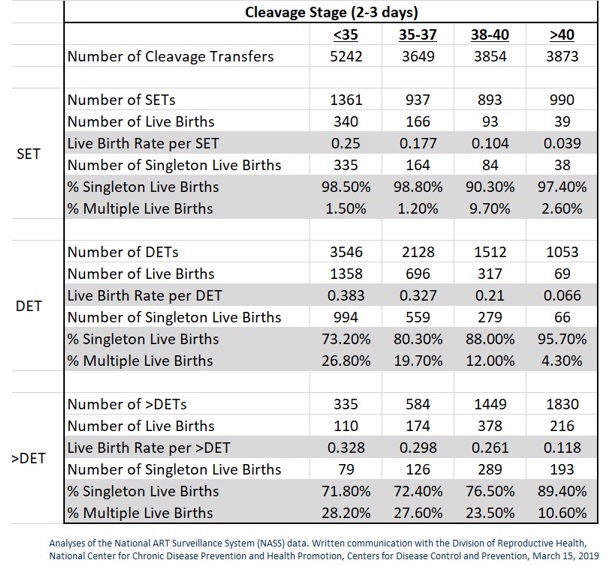
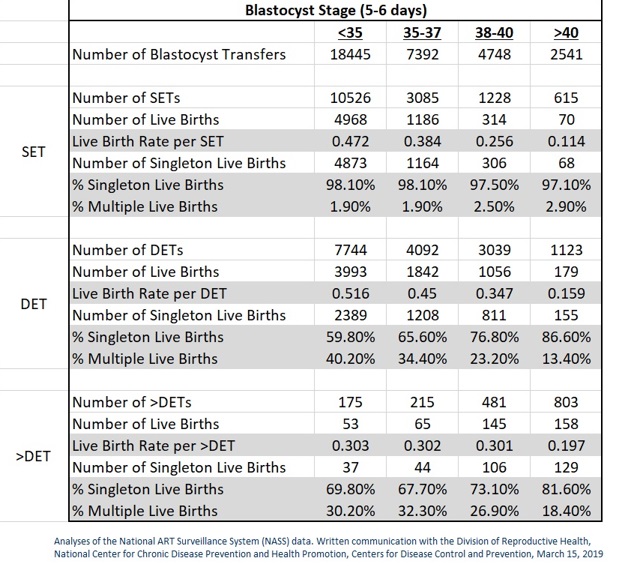
And here’s some stats based on transferring a single embryo of varying quality (average age around 31) (from Bouillon et al. 2017)
- Good quality: 46.8% live birth
- Fair quality: 39.0% live birth
- Poor quality: 34.1% live birth
- Early blast: 28.9% live birth
And here’s a calculator that will do the math for you, along with more details on how to calculate this.
Note that these calculators below provide estimates on the cumulative chances for overall success of multiple cycles, not for individual cycles. They’re based on formulas from Polyakav et al. (2021), and using these calculators may be inaccurate for your situation. The best estimates for your chances of success will come from your clinic and doctor.
Note that this is a quick and dirty kind of way to calculate this. More accurate rates will come from studies that look at actual people having these transfers done consecutively (like the Pirtea et al. study above).
What can be done with repeated failed embryo transfers?
So how is this information helpful? It gives an idea of when to start considering other options, in consultation with your doctor. With 3 failed euploid transfers, embryo quality (and by extension, egg and sperm quality) may not be the reason things aren’t working out.
There are many different reasons embryos can fail to implant or miscarry, which you can discuss with your doctor. These include:
- Lifestyle choices
- Infection/endometritis
- Vaginal and endometrial microbiota
- Anatomical abnormalities (fibroids, etc.)
- Thrombophilia
- Immunological issues
- The doctor’s ability to perform a transfer
- The lab’s quality
I cover all these topics in more detail in my post Why do embryos in IVF fail to implant or miscarry?

About Embryoman
Embryoman (Sean Lauber) is a former embryologist and the founder of Remembryo, an IVF research and fertility education website. After working in an IVF lab in the US, he returned to Canada and now focuses on making fertility research more accessible. He holds a Master’s in Immunology and launched Remembryo in 2018 to help patients and professionals make sense of IVF research. Sean shares weekly study updates on Facebook, Instagram, and Reddit regularly. He also answers questions on Reddit or in his private Facebook group.