

Researchers in a 2023 study found that day 7 euploids have the lowest ongoing pregnancy rate, when compared to day 5 and 6 euploids. These embryos were mostly poor quality.
Blastocysts can develop on day 5, 6 or 7. Success rates tend to decrease the longer it takes for a blastocyst to develop. You can read more about embryo develop and success rates here.
This study compared pregnancy outcomes for patients that transferred a day 5, 6 or 7 euploid.
🔗 Original studies are referenced in this post or within the linked Remembryo posts.
💡 Reminder: Terms underlined with a dotted black line are linked to glossary entries. Clicking these does not count toward your paywall limit.
Study details
This section covers key details of how the study was performed, including patient characteristics, how they were treated, and other methods used. For those who aren’t interested in these details, and just want to see the results, you can go ahead and skip this part.
- This study took place at a single IVF center in the United Arab Emirates between 2017 and 2022.
- A single euploid was transferred, with a quality 3CC or higher (no early blastocysts).
- The primary outcomes was the ongoing pregnancy rate.
- Ongoing pregnancy rates were any pregnancies after 6 weeks. Miscarriages were any loss of a pregnancy after 4 weeks.
The way they define an ongoing pregnancy rate in this study is unusual, and is more like how a clinical pregnancy is defined (which they define as 4 weeks in this study). Often, ongoing pregnancies are 20+ weeks.
In terms of the sample size, there were a total of 1,527 patients:
- Day 5 euploids (855 patients)
- Day 6 euploids (636 patients)
- Day 7 euploids (36 patients)
Unfortunately the number of patients who transferred day 7 embryos was low. This is typical for these studies, because day 7s are given the lowest priority (after day 6 and day 5).
In terms of baseline characteristics, there were differences in female age (range 33.2 to 35.9, with day 7s being the oldest), male age, AMH, BMI and proportion of patients using ICSI. To control for these differences, these were statistically adjusted in their analysis.
Day 7 embryos more likely to be poor quality
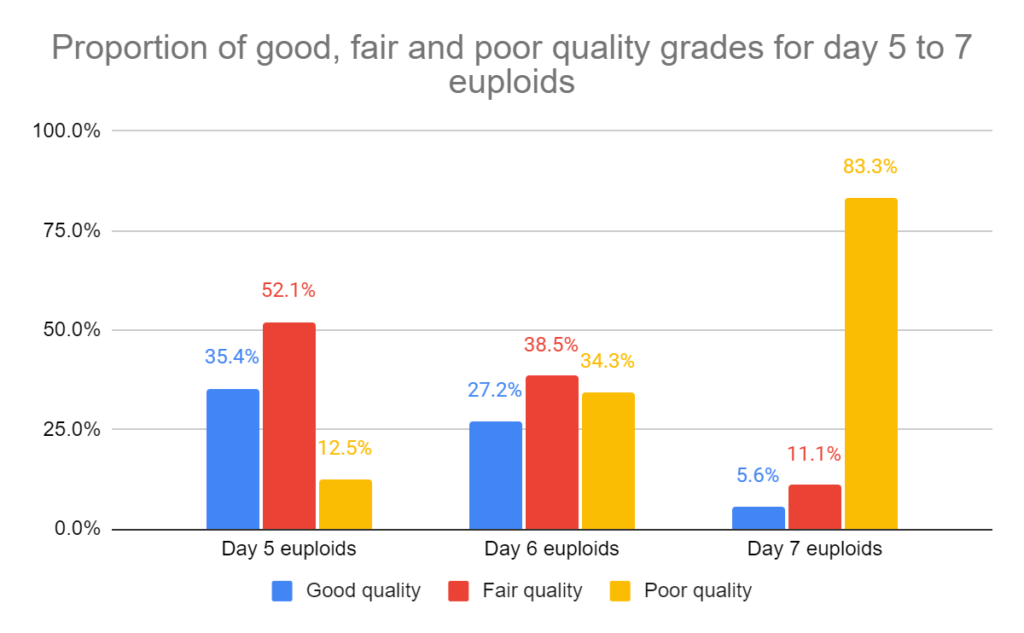
Embryos were grouped based on their quality. Good quality embryos were AA, AB or BA; fair quality embryos were BB; poor quality embryos were AC, BC, CC, CA and CB. All embryos were expansion 3 or higher. If you’re not clear on what this means, you can read more about embryo grading here.
You can see the distribution of good, fair and poor quality euploids below. Day 7 euploids were much more likely to be poor quality.
Day 7 euploids had the lowest ongoing pregnancy rate
They transferred a single day 5, 6 or 7 euploid to patients and reported the ongoing pregnancy, live birth and miscarriage rates.
The ongoing pregnancies were pregnancies after 6 weeks, and the live births were any births reported in the time frame of the study. They did it this way so they could publish their data more quickly rather than waiting for the live births.

There was a decrease in ongoing pregnancy rates with day 5 vs day 6 euploids, although this wasn’t significant after statistical adjustment (56.0% vs 45.3%, p< 0.001; adjusted odds ratio [95% CI]: 0.82 [0.65-1.03]). This means that after they controlled for differences between patients, there was no difference between day 5 and 6 ongoing pregnancy rates.
Day 7 euploids had the lowest ongoing pregnancy rate, which was significantly different from day 5 (11.1% vs 56.0%, p< 0.001; adjusted odds ratio [95% CI]: 0.23[0.08-0.62]). This shows that day 7 euploids had an ongoing pregnancy rate that was about 4 times lower than day 5 euploids.
Live birth rates were also lower for day 5-7 (p< 0.001). There were no statistically significant differences for miscarriage rates.
Factors associated with day 7 embryo development
The authors performed an analysis to see what factors were associated with getting day 7 euploids.
They found that as female and male age increased, so did the chance of getting a day 7 euploid. As AMH levels decreased, the chances of getting a day 7 also increased.
Conclusions
This study found that day 7 euploids had a lower ongoing pregnancy rates compared to day 5 and day 6 (11.1% vs 56.0% and 45.3%).
The majority of day 7 euploids were poor quality. They also found that day 7s were more common with increasing female and male age.
Poor quality embryos generally have a lower success rate compared to fair and good quality embryos. Better quality day 7 embryos would likely have better outcomes. In fact, given that about 83% of the day 7 euploids were low quality, this study is more of a look at outcomes for poor quality day 7 euploids. A 2019 study found that good quality day 7 euploids had a 26.4% chance of live birth (read more in my post Study examines potential of day 7 euploid transfers).
Another limitation of this study is the small sample size for day 7 euploid transfers. This is because day 7 embryos are prioritized after day 5 and day 6.
Related studies
For more info on day 5 vs day 6 vs day 7 embryos, check the archive here.
Not all research may agree with this study. There were a number of studies referenced in this study that you might want to check out, as shown below (8 links):

Reference

About Embryoman
Embryoman (Sean Lauber) is a former embryologist and the founder of Remembryo, an IVF research and fertility education website. After working in an IVF lab in the US, he returned to Canada and now focuses on making fertility research more accessible. He holds a Master’s in Immunology and launched Remembryo in 2018 to help patients and professionals make sense of IVF research. Sean shares weekly study updates on Facebook, Instagram, and Reddit regularly. He also answers questions on Reddit or in his private Facebook group.
Related posts:
 Complete Guide to Embryo Grading and Success Rates
 Transfer of day 7 embryos a viable option
 Predicting live birth rates, multiples based on 223,377 transfers
 Comparable outcomes with good quality day 6 and poor quality day 5 embryos
 Study evaluates the potential of day 4, 5, 6 and 7 blastocysts
 Poor quality blastocysts show acceptable live birth rates, no change in perinatal outcomes
 Day 3 or Day 5 embryo transfer?
 Meta-analysis combines 74 studies to examine factors linked to euploid transfer success