

Let’s take a look at the top 5 IVF studies from 2023!
These are the top 5 posts that got the most engagement on social media or the most page views here on Remembryo.
These are summaries of the posts — if you want to read the full post, you can click on the picture or scroll to the end of the summary to get the link.
🔗 Original studies are referenced in this post or within the linked Remembryo posts.
💡 Reminder: Terms underlined with a dotted black line are linked to glossary entries. Clicking these does not count toward your paywall limit.
Table of Contents
Immature eggs cultured overnight by rescue IVM show promising IVF outcomes
Many IVF cycles result in immature eggs and are normally discarded, but continued culture of these immature eggs by rescue in vitro maturation (rescue IVM), may be a viable way to maximize the number of mature eggs in an IVF cycle.
Shani et al. (2023) compared IVF outcomes of rescue IVM eggs and mature sibling eggs. The immature eggs were cultured overnight for a period of 17-24 hours after the retrieval, using standard culture media (1-step, because time-lapse was done).
This study found that a high proportion of rescue IVF eggs became mature overnight, and had comparable fertilization rates to sibling mature eggs, but they were less likely to convert to blastocyst (more of them arrested).
Despite this, once a rescue IVM embryo became a blastocyst, there were no differences in euploidy rates compared to embryos from sibling mature eggs.
Due to the clinic’s policy of prioritizing embryos from normally matured eggs, it was difficult to make comparisons with pregnancy outcomes since only 20 embryos were transferred (3 live births, 4 miscarriages).
“For some patients, using rescue IVM prevents cycle cancellation due to a lack of mature oocytes at retrieval or a lack of embryos suitable for transfer. For others, rescue IVM provides additional blastocysts available for transfer, therefore, potentially enhancing the probability of achieving a pregnancy and a live birth.”
You can read my full summary of this post here.
Protected sex the night before frozen embryo transfer linked to improved outcomes
Having sex while undergoing IVF has been linked to positive pregnancy outcomes, usually as a result of exposure to semen, but it’s not clear if sexual intercourse itself, in the absence of semen, can improve pregnancy outcomes during a frozen embryo transfer (FET).
Hou et al. (2023) performed a randomized controlled trial (RCT) that compared FET outcomes in patients who had condom-protected sex the night before the procedure or abstained.
They found improved implantation and pregnancy rates in patients who had sex compared to those who didn’t, with no differences in biochemical loss or miscarriage rates.
The authors explain that these positive results may be due to increased blood flow to the female genital region, which possibly could improve endometrial receptivity.
“In summary, clinical data obtained from this study demonstrate that the “physical” component of sexual intercourse before the day of embryo transfer may improve clinical pregnancy and implantation rates during FET cycles.”
You can read my full summary of this post here.
Pilot study shows improved IVF outcomes after spindle transfer in women with poor egg quality
Infertility can be attributed to poor egg quality, which may be due to faulty mitochondria that have problems in producing energy. Meiotic or maternal spindle transfer involves transferring the DNA of the patient’s egg into a healthy donor egg that has had its nucleus and DNA removed (enucleated). The result is a donor egg that has the patient’s DNA, but the donor’s mitochondria.
For the first time, Costa-Borges et al. (2023) performed a maternal spindle transfer in 25 women with infertility that was attributed to poor egg quality, and examined IVF and neonatal outcomes.
They found that these women had improved fertilization rates and good quality blastocyst production. Previously, none of the 25 women had been pregnant after an average of 6.4 ovarian stimulation cycles, but after maternal spindle transfer 6 of them went on to have a live birth. All the babies were healthy.
In one of the babies there was significant carryover of maternal mitochondria. The authors state that it’s not clear what impact the donor/patient mitochondria combination may have on the development of the child and longer studies are needed.
“While the data obtained is encouraging, with successful pregnancies achieved by patients with a long history of extremely poor IVF treatment outcomes, it must be acknowledged that the study was only a pilot and as such was limited in size and scope. A definitive assessment of therapeutic value must await well-controlled phase II or phase III trials [that are] adequately sized, carefully designed and appropriately regulated.”
You can read my full summary of this post here.
A look at how PGT-A results change with age, using data from over 86,000 biopsies
Armstrong et al. (2023) share the distribution of euploid, mosaic and aneuploid PGT-A results from the biopsy of over 86,000 embryos across age groups (using data from CooperSurgical).
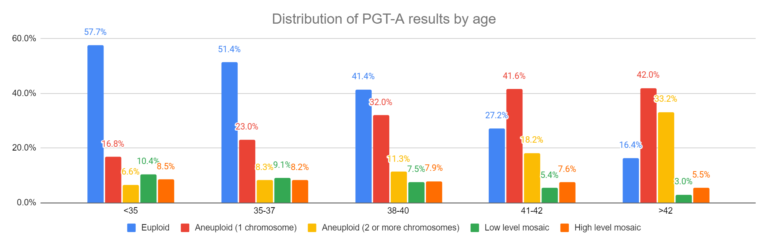
In general, as age increased, euploid and mosaic rates dropped, while aneuploid rates increased. Overall, about 16% of embryos biopsied were mosaic.
For both high and low-level mosaic results, each age group had roughly an equal 50:50 split.
Older patients had more whole chromosome mosaics, and younger patients had more segmental mosaics.
Having mosaic results in one cycle didn’t increase the chance of having mosaic results in future cycles.
By including both mosaics and euploids, there are more embryos available for transfer. This is important for older patients, who have a higher chance of having a PGT-A cycle without a euploid.
You can read my full summary of this post here.
Study evaluates factors affecting pregnancy outcomes after euploid transfer
A number of factors can influence pregnancy outcomes following euploid embryo transfer. Vidales et al. (2023) wanted to better understand these factors and examined the outcomes (pregnancy, live birth, miscarriage rates) of 1,660 frozen embryo transfers.
They found:
➡️ Double euploid transfers led to increased pregnancy and live birth rates, while also increasing rates of miscarriage and multiples.
➡️ High BMI had a negative effect on euploid pregnancy outcomes.
➡️ Natural cycle FETs had improved outcomes compared to medicated FETs.
➡️ Embryos biopsied on day 5 showed improved outcomes compared to day 6 and day 7 euploids.
➡️ No effect of age or AMH on euploid pregnancy outcomes.
You can read my full summary of this post here.
Related posts:
 Risk of poor ovarian response with repeat IVF cycles
 How many embryos to transfer? 2021 ASRM recommendations
 Comparing frozen embryo transfer/FET protocols
 Can sperm and egg be “genetically incompatible”?
 Fresh or frozen embryo transfer? Results of the E-Freeze clinical trial
 Embryologist and physician success rates variable, not related to experience
 Meta-analysis compares impact of endometriosis on IVF, obstetric and perinatal outcomes
 Prolonged embryo storage >6 years may reduce pregnancy, live birth rates