
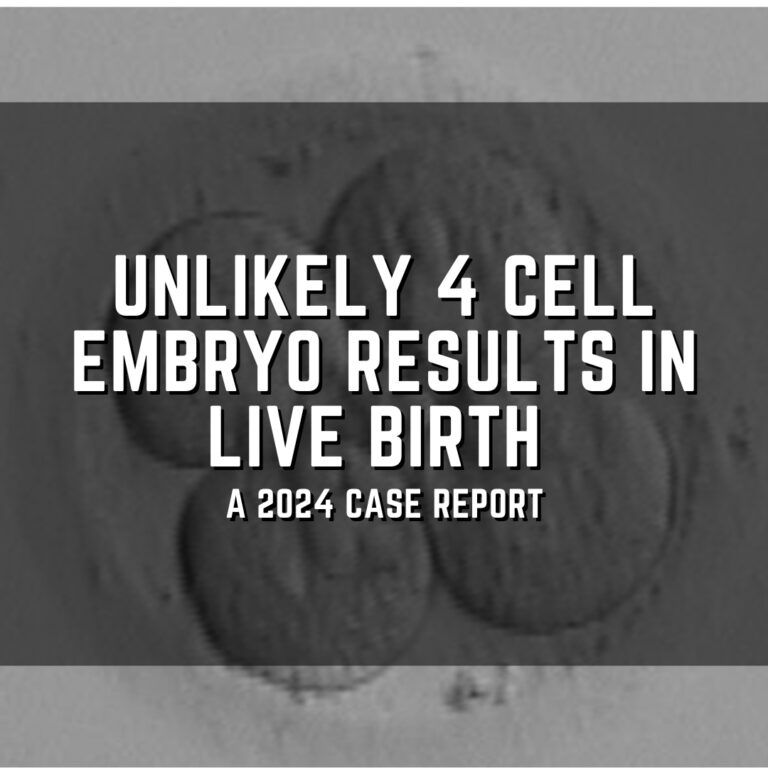
A 2024 case report details a patient who had success transferring a 4 cell embryo on day 4 — an embryo that some clinics wouldn’t have considered for transfer.
🔗 Original studies are referenced in this post or within the linked Remembryo posts.
💡 Reminder: Terms underlined with a dotted black line are linked to glossary entries. Clicking these does not count toward your paywall limit.
A 37 year old patient with diminished ovarian reserve (AMH <0.06 ng/mL) had attempted IVF since 2014:
- Between 2014 and 2015, she had 3 egg retrievals and 3 embryo transfers, which didn’t work.
- In 2017, she had an IVF cycle and retrieved one egg that resulted in a 3 cell embryo on day 2. The transfer didn’t work.
- After a break, she had another IVF cycle, resulting in a single 0PN zygote that developed to 4 cells on day 3. This was frozen.
- She was encouraged to have more egg retrieval to get more eggs. After two more retrievals, she ended up with two embryos (an 8- and 7-cell) on day 4, which didn’t work after transfer.
In total, the patient had six IVF cycles and five transfers, with no luck. She still had a frozen day 3 embryo with 4 cells, which is a low number (typically around 8 cells are expected on day 3). The couple decided to thaw this embryo as a last effort, and stop treatment afterwards.
The 4-cell embryo was thawed on day 3 and allowed to grow for another day to ensure viability. On day 4, there were still 4 cells, suggesting that the embryo had arrested its development. Even though it didn’t grow further, the couple decided to transfer the embryo anyway.

It was successful! After 14 days, serum beta-hCG measured 575.2 mIU/ml. At 39 weeks pregnancy, a healthy baby girl was delivered.
This is a pretty remarkable success story, I think. She was a bit older, with a history of multiple failed transfers, who transferred a 0PN embryo with a very low cell number that showed signs of embryo arrest. Many clinics would not have transferred this embryo.
The authors note that this is a very rare outcome, but this is based on their experience. For clinics that are willing to transfer these types of embryos, it may not be so rare afterall. So what kind of success rates do 4 cell embryos have on day 3?
- Zhao et al. (2014) showed that 31.7% of day 3 4 cell embryos developed into blastocysts, mostly on day 6. The live birth rates of these blastocysts wasn’t any different compared to blastocysts from day 3 embryos with more than 4 cells (38.2% vs 42.2%).
- Ertzeid et al. (2003) showed that transferring an average of 1.56 day 3 4 cell embryos to a ~32 year old patient resulted in a live birth rate of about 5% (compared to 24% for 8 cell embryos, where 1.86 embryos were transferred to a similarly aged patient).
But the above is for day 3 4-cell embryos. The embryo in this case report was 4 cells on day 4, so we would expect the success rates to be even lower! To read more about day 3 embryos and their success rates, check this post.
Although it’s rare, this goes to show that even the unlikeliest of embryos can work!
Another factor that may have been at play here is that this was her first frozen transfer. The authors note that this may have resulted in better synchronization with the endometrium. Regardless, it’s still very impressive that a 4 cell embryo on day 4, after exhibiting signs of embryo arrest, still worked!
But what about its 0PN status? Fertilization is verified by the presence of 2 pronuclei (2PN) on day 1 after insemination. Seeing no pronuclei indicates that fertilization didn’t occur, however it’s possible that the pronuclei haven’t formed yet or have already fused. It takes time for the pronuclei to form, and after they form, they disappear! You can read more about this in my post Abnormal fertilization and the potential of 0PN, 1PN and 3PN zygotes.
Reference

About Embryoman
Embryoman (Sean Lauber) is a former embryologist and the founder of Remembryo, an IVF research and fertility education website. After working in an IVF lab in the US, he returned to Canada and now focuses on making fertility research more accessible. He holds a Master’s in Immunology and launched Remembryo in 2018 to help patients and professionals make sense of IVF research. Sean shares weekly study updates on Facebook, Instagram, and Reddit regularly. He also answers questions on Reddit or in his private Facebook group.
Related posts:
 Complete Guide to Embryo Grading and Success Rates
 Embryo Arrest
 Predicting how many day 3 embryos make it to blastocyst
 Predicting live birth rates, multiples based on 223,377 transfers
 Age-specific blastocyst conversion rates and other IVF outcomes in good prognosis women
 Blastocyst and pregnancy rates of day 3 embryos based on cell number, fragmentation
 Aneuploidy is a key factor in embryo arrest
 Day 3 or Day 5 embryo transfer?