
A 2026 meta-analysis combined the results of 105 studies to examine the causes of recurrent pregnancy loss (RPL), finding that unexplained RPL and acquired thrombophilia were the most common.
RPL is usually defined as having two or more pregnancy losses, but determining the cause can be difficult.
Different studies and guidelines have reported very different frequencies of conditions like antiphospholipid syndrome (APS), uterine abnormalities, endocrine disorders, inherited thrombophilias, and chromosomal issues. In many cases, no clear cause is identified.
To better estimate how common these causes are, Carvalho et al. (2026) combined the results of 105 studies involving nearly 48,000 women with RPL in a systematic review and meta-analysis. The researchers also looked at how often RPL itself occurred in the general population.
For more background, read my post on Why do embryos in IVF fail to implant or miscarry?
🔗 Original studies are referenced in this post or within the linked Remembryo posts.
💡 Reminder: Terms underlined with a dotted black line are linked to glossary entries. Clicking these does not count toward your paywall limit.
Study details
- Study design: Systematic review and meta-analysis of 105 observational studies published between 1995 and 2025.
- Participants: 47,907 women with recurrent pregnancy loss for the etiological analysis.
- RPL definition: Most studies defined RPL as either ≥2 or ≥3 pregnancy losses.
How common was recurrent pregnancy loss?
Using the two eligible population-based studies that consisted of about 1.4 million patients, the researchers estimated that RPL affects about 1% of women.
However, only two population-based studies met inclusion criteria, so the authors noted this estimate should be interpreted cautiously.
What were the most common reported causes of RPL?
The researchers grouped recurrent pregnancy loss (RPL) into several major categories based on the diagnoses reported in each study. However, not all studies evaluated the same conditions or used the same diagnostic criteria, and some patients had more than one identified factor, meaning these categories overlap and do not add up to 100%.
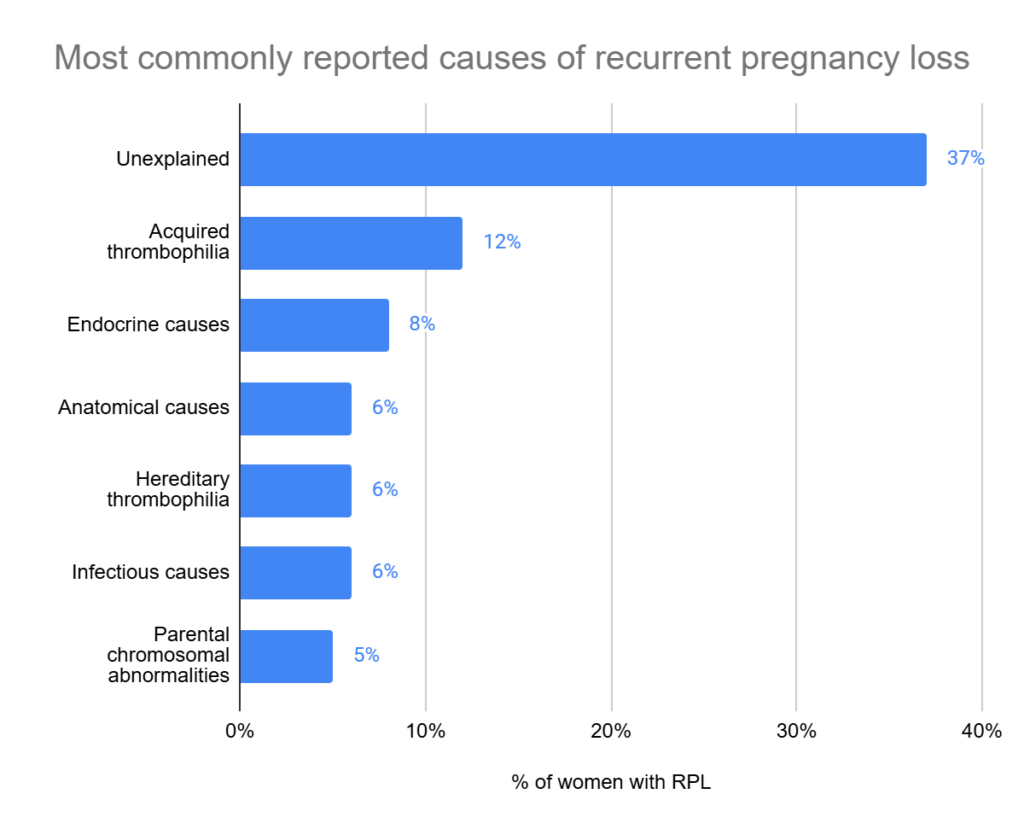
Unexplained RPL (37%, 95% CI: 30–44%, 21 studies, 5468 participants, I2= 94.3%). This category included patients where no clear cause of RPL was identified after evaluation. However, what counted as “unexplained” varied between studies depending on which tests were performed. Some studies included genetic testing of miscarriage tissue or detailed immune and endocrine evaluations, while others used more limited workups. Across studies, investigators commonly excluded parental chromosomal abnormalities, uterine abnormalities, endocrine disorders, antiphospholipid syndrome, inherited thrombophilias, and infections before classifying patients as unexplained. Some studies also excluded autoimmune conditions, obesity, smoking, or vitamin D deficiency.
Acquired thrombophilia (12%, 95% CI: 9–15%, 56 studies, 17,185 participants, I2= 95.9%). This category mainly referred to antiphospholipid syndrome (APS), an autoimmune condition where antibodies increase the risk of blood clotting and may interfere with placental development and blood flow during pregnancy. They included classical antibodies such as lupus anticoagulant, anticardiolipin antibodies, and anti-beta-2-glycoprotein I antibodies, as well as other non-classical antibodies.
Endocrine causes (8%, 95% CI: 6–10%, 45 studies, 14,868 participants, I2= 95.7%). This category included hormonal and metabolic conditions like PCOS, prolactin imbalances, thyroid antibodies, luteal phase defect, diabetes mellitus, thyroid disease, and subclinical hypothyroidism.
Anatomical causes (6%, 95% CI: 5–8%, 49 studies, 17,910 participants, I2= 93.7%). Anatomical causes referred to structural abnormalities of the uterus or cervix that may interfere with implantation or pregnancy. These included congenital uterine anomalies (septate uterus, arcuate uterus, bicornuate uterus, unicornuate uterus, and double uterus), acquired uterine structural abnormalities (intrauterine adhesion, hysteromyoma, and adenomyosis), and cervical insufficiency.
Hereditary thrombophilia (6%, 95% CI: 5–8%, 39 studies, 10,536 participants, I2= 95.3%). This category included inherited clotting-related genetic variants such as Factor V Leiden mutation, prothrombin mutation, MTHFR, and protein C or protein S deficiencies.
Infectious causes (6%, 95% CI: 3–11%, 15 studies, 3967 participants, I2= 89.7%). This category included conditions such as chronic endometritis, genital tract infections, bacterial vaginosis, and other infections.
Parental chromosomal abnormalities (5%, 95% CI: 4–6%, 49 studies, 22,481 participants, I2= 93.0%). This category involved chromosomal abnormalities in the parents, such as balanced translocations, which can increase the chance of embryos having missing or extra genetic material.
Genetic testing appeared to reduce the “unexplained” category
The researchers also found that studies performing chromosomal testing on miscarriage tissue reported lower rates of unexplained RPL.
- Without testing: 39% (95% CI: 32–47%)
- With testing: 23% (95% CI: 14–34%)
This suggests that some unexplained RPL cases may actually involve recurrent embryo aneuploidy that was never identified, however this was based on only 3 studies so more research is needed here.
Conclusion
This meta-analysis found that unexplained RPL remains the largest category, accounting for about 37% of cases, while acquired thrombophilia was the most commonly identified specific cause. Endocrine, anatomical, inherited thrombophilia, infectious, and chromosomal causes were each reported in smaller proportions.
One interesting result was that studies using genetic testing of miscarriage tissue reported lower rates of unexplained RPL. This suggests that recurrent embryo aneuploidy may account for some unexplained cases. This idea is also consistent with a recent study by Xu et al. (2025) who showed that most patients with RPL who transfer up to 3 euploid embryos go on to have a live birth. This also reinforces that many miscarriages are likely embryo-related, particularly due to chromosomal abnormalities, and it makes it hard to study RPL without knowing this.
The authors also highlight how difficult it is to compare studies directly because definitions of RPL, diagnostic criteria, and testing strategies vary substantially between clinics and countries. For example, some studies performed extensive endocrine or thrombophilia testing, while others used more limited evaluations. Some uterine conditions, such as adenomyosis, may also be underdiagnosed depending on the imaging methods used. These differences likely contributed to the high variation between studies (high I2 values).
Importantly, this meta-analysis reflects the causes that were identified during RPL evaluations performed across these studies, meaning the results are heavily influenced by what clinicians were actually testing for at the time.
Endometriosis was not specifically identified as a major RPL category in this meta-analysis, despite growing evidence linking it to miscarriage risk (Boje et al. 2023). One possible reason is that many of the studies included here were based on older RPL workups focused more on factors like thrombophilia, while endometriosis has only more recently started receiving attention as a possible contributor to recurrent miscarriage. This may be true for other contributors also, like immune dysfunction.
Many people attribute RPL to immune dysfunction. In this study, acquired thrombophilia accounted for 12% of RPL cases, and some thyroid autoimmunity was also included in the endocrine category. However, other proposed immune causes, such as abnormal NK cell levels or Th1/Th2 imbalance, were not specifically represented here. Current evidence hasn’t consistently shown that these immune tests or immunotherapies improve outcomes, and some experts recommend limiting these approaches to research settings until stronger evidence is available.
At the same time, successful implantation and pregnancy do rely on careful immune regulation, and researchers are still trying to better understand which immune pathways are important for RPL. As we learn more, RPL diagnostic workups may expand to include factors like endometriosis and immune dysfunction, and some of the cases currently labeled as “unexplained” may eventually become better understood.
Limitations include the high heterogeneity between studies, inconsistent RPL definitions (≥2 vs ≥3 losses), variable diagnostic workups, and limited population-level prevalence data. Many studies also did not genetically test miscarriage tissue, making it difficult to separate embryo-related losses from those potentially related to maternal factors.
Want to read more about RPL?
This post covers the variety of reasons embryos can fail to implant or miscarry, including as a result of advanced maternal age, chromosomal translocations, lifestyle, endometritis, the microbiota, immunological issues, endometrial receptivity, the clinic, and more. Note that this is not a complete list, and will be updated periodically. Read more.
A 2024 study found that patients with recurrent pregnancy loss have congenital uterine anomalies at a rate of 8-19%, with 23% having adenomyosis. Read more.
A 2025 study suggests that most patients with recurrent pregnancy loss who transfer up to 3 euploid embryos go on to have a live birth, though data from later transfers are limited. Read more.
Successful embryo implantation and pregnancy depends on careful control of the immune system. In this post, we'll explore the general workings of the immune system and its role in pregnancy, examining how dysregulation of immune cells like natural killer (NK) cells and macrophages can impact fertility. Additionally, we'll look into autoimmunity and discuss how immunotherapies may be used to improve IVF outcomes. Read more.
Reference

About Embryoman
Embryoman (Sean Lauber) is a former embryologist and the founder of Remembryo, an IVF research and fertility education website. After working in an IVF lab in the US, he returned to Canada and now focuses on making fertility research more accessible. He holds a Master’s in Immunology and launched Remembryo in 2018 to help patients and professionals make sense of IVF research. Sean shares weekly study updates on Facebook, Instagram, and Reddit regularly. He also answers questions on Reddit or in his private Facebook group.