

A 2025 study found that while poor quality blastocysts are less likely to be euploid, some can still lead to healthy live births. Tested poor quality embryos had higher live birth rates and lower miscarriage rates than untested ones, especially when they developed by day 5 instead of day 6.
Embryo quality is important for guiding transfer decisions in IVF, with poor quality blastocysts sometimes discarded because of their lower chance of success.
However, research shows that poor quality embryos can still be euploid and result in live births.
A new study by Al Hashimi et al. (2025) reported on euploidy rates and live birth rates for poor quality embryos.
For more background on embryo quality, check my Complete guide to embryo quality and success rates.
🔗 Original studies are referenced in this post or within the linked Remembryo posts.
💡 Reminder: Terms underlined with a dotted black line are linked to glossary entries. Clicking these does not count toward your paywall limit.
Study details
- Study type: Retrospective cohort study that took place between 2015–2024 at a single IVF clinic in London
- Participants: 2,258 PGT-A cycles from 1,344 patients:
- Resulted in 7,332 blastocysts that were tested for PGT-A, including about 2,500 good, 2,100 fair, and 1,200 poor quality embryos.
- There were 74 transfers with a single poor quality euploid (69 patients) and 192 transfers with a single untested poor quality embryo (180 patients). The average age for euploid transfers was 37.7 vs 34.9 for untested (p= 0.0002).
- Embryo grading: Good quality was considered AA, AB, BA, BB; Fair quality was considered BC, CB; and poor quality was considered CC, CD, DC, DD.
- Primary outcome: Live birth rate from a single poor quality embryos.
- Statistical adjustment: In this study, they adjusted for blastocyst quality, maternal age (at collection and transfer), ART method (ICSI vs. IVF), day of blastocyst freezing/transfer, and expansion grade.
Euploid rates drop with poorer quality and older age
In this study, embryos were graded using the ACE/NEQAS system rather than the standard Gardner system. The key difference is that ACE/NEQAS includes a grade D in addition to A–C. A D grade for the ICM or trophectoderm indicates very few cells, cells that are not clearly visible, or cells that are degenerating. In the Gardner system, these embryos would still fall into the C category, so a D grade in ACE/NEQAS represents a very poor-quality embryo.
From analysis of over 7,000 blastocysts, the researchers found that good-quality blastocysts had a higher chance of being euploid compared with fair or poor-quality blastocysts. As expected, the chance of euploidy also declined with age.
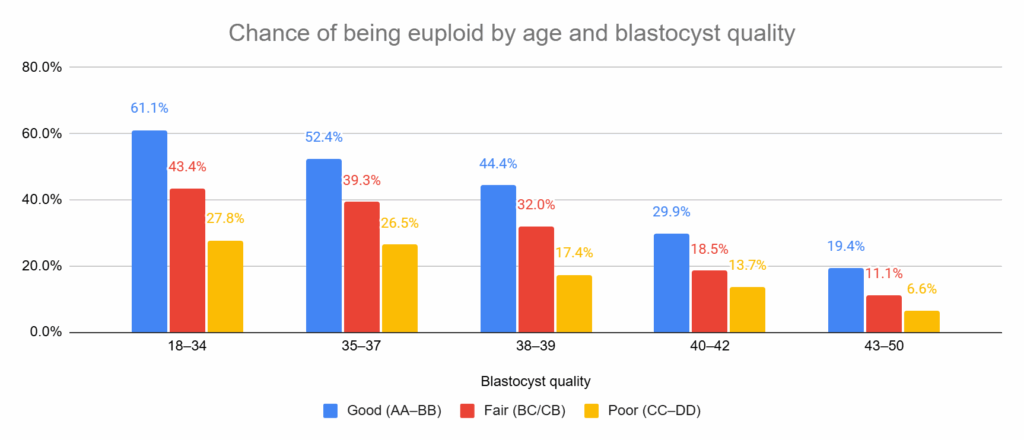
Good quality blastocysts had the best chance of being euploid, while lower quality embryos showed reduced odds — about 38% lower for fair quality embryos (odds ratios [95% CI]: 0.62 [0.55–0.70]) and about 62% lower for poor quality embryos (odds ratio [95% CI]: 0.38 [0.32–0.45]) compared to good quality embryos.
Day of development influences chance of euploid
Blastocyst quality also varied by the day of development at biopsy. Most embryos biopsied on day 5 were good quality, while most biopsied on day 6 were fair or poor quality.
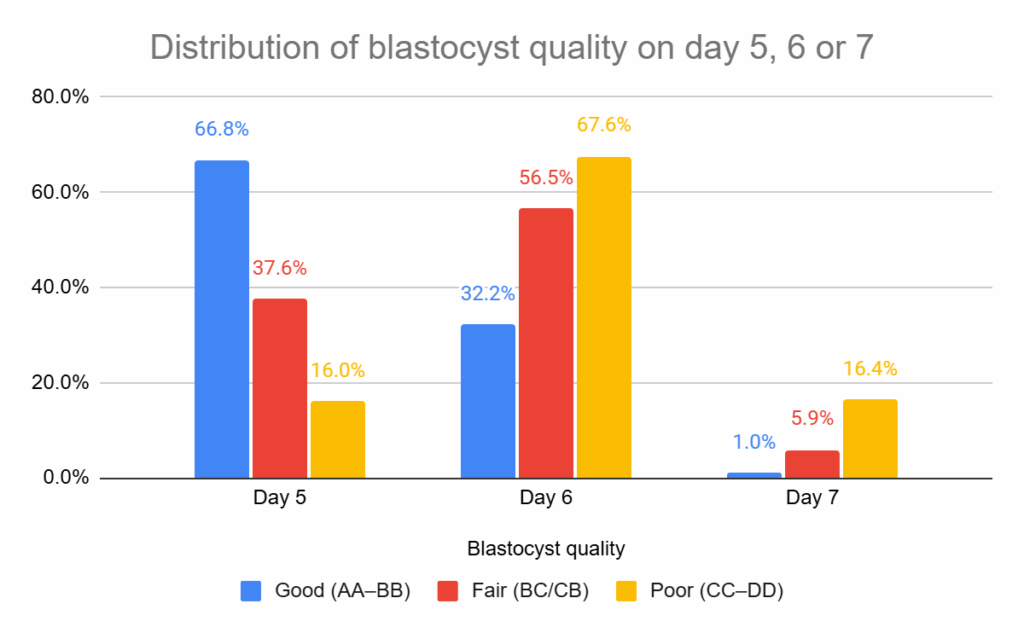
The day of development itself can also influence the chance of being euploid:
- They found that day 5 blastocysts were the most likely to be euploid.
- Compared to day 5, day 6 blastocysts had about 30% lower odds of being euploid (adjusted odds ratio [95% CI]: 0.70 [0.62–0.78])
- Compared to day 5, day 7 blastocysts had about 55% lower odds of being euploid (adjusted odds ratio [95% CI]: 0.46 [0.34–0.61).
Poor quality euploids have higher live births than untested embryos
When comparing transfer outcomes of poor quality blastocysts (quality CC-DD), PGT-A testing did not change the chance of pregnancy (not statistically significant), but it was linked with a lower miscarriage rate (p= 0.003) and a higher live birth rate (p= 0.004).
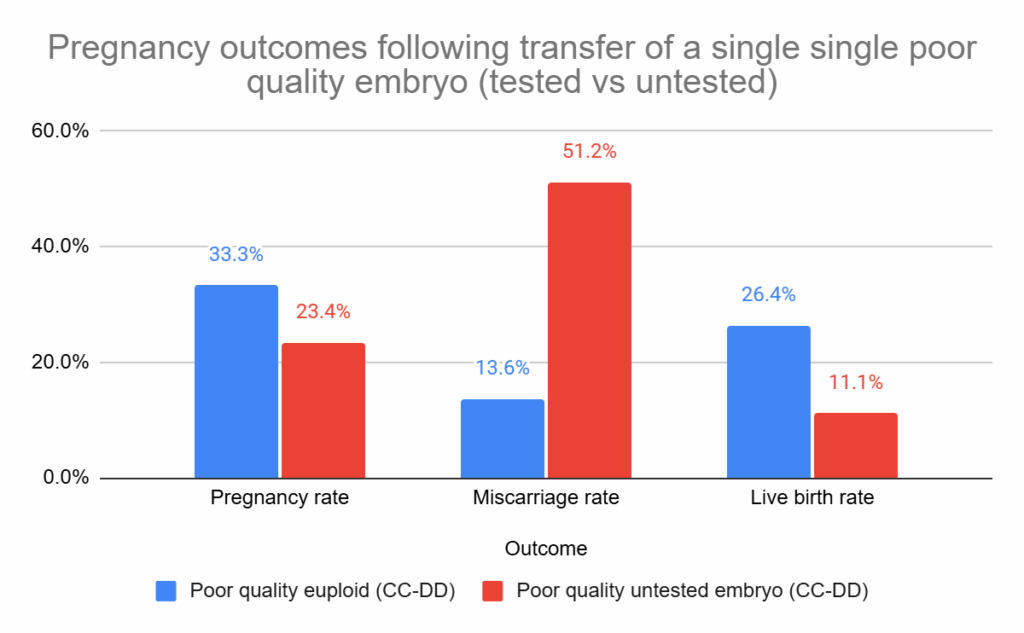
Outcomes also depended on the day of development, with day 5 blastocysts performing best, day 6 showing about 78% lower odds of live birth (adjusted odds ratio [95% CI]: 0.22 [0.10–0.48]), and no live births seen from day 7.
They found no differences in gestational age or birth weights of the babies.
Conclusions
This study shows that embryo grade, maternal age, and day of development all play a role in the likelihood of an embryo being euploid. While poor quality blastocysts (CC–DD) are less likely to be chromosomally normal, some can still result in healthy live births.
Transfers of untested poor quality embryos led to live births in about 1 in 10 cases, compared with about 1 in 4 when PGT-A was used. Day 5 embryos had the best outcomes, while day 6 embryos had about 80% lower odds of live birth, and no live births were seen from day 7 embryos (there weren’t many day 7s in this study).
In my opinion, CC-quality embryos shouldn’t be automatically discarded because they still have potential and this should be discussed with your doctor. For clinics that do discard them, the authors of this study suggest that testing first may be worth it, since euploid poor quality embryos have a higher chance of live birth compared to untested.
It’s important to note that in some poor quality embryos, there may not be enough cells to safely perform a biopsy, and in those cases the decision should be left to the embryologist’s judgment.
Limitations include the retrospective design, single-center setting, small number of poor quality embryo transfers, and differences in patient age between tested and untested groups. Still, these findings support reconsidering the routine discard of poor quality embryos without genetic testing.
Want to read more about how IVF success rates are influenced by embryo quality and development day?

Not sure what your embryo grade means—or if it affects your chances of success? This guide walks you through everything from day 3 and day 5 grading systems to what each number and letter combo (like 3BB or 5AA) actually means. You'll also find success rate research, embryo photos, and insights from a former embryologist to help make sense of your report. Read more.

This post takes a closer look at what “poor-quality” embryos really mean in IVF. At the cleavage stage, they often have fewer cells or high fragmentation, while at the blastocyst stage, a grade C means the inner cell mass and trophectoderm contain fewer, loosely packed cells. These embryos tend to have lower success rates than good-quality ones, but studies show they can have similar perinatal outcomes. Read more.

Researchers in a 2022 study showed that extending embryo culture to day 7 increases the number of useable blastocysts, particularly for older women. Read more.

Researchers in a 2019 study compared euploid transfer outcomes for day 5, 6 or 7 euploids, finding that day 7 embryos have good potential. Read more.
Reference

About Embryoman
Embryoman (Sean Lauber) is a former embryologist and the founder of Remembryo, an IVF research and fertility education website. After working in an IVF lab in the US, he returned to Canada and now focuses on making fertility research more accessible. He holds a Master’s in Immunology and launched Remembryo in 2018 to help patients and professionals make sense of IVF research. Sean shares weekly study updates on Facebook, Instagram, and Reddit regularly. He also answers questions on Reddit or in his private Facebook group.
Related posts:
 Transfer of day 7 embryos a viable option
 Complete Guide to Embryo Grading and Success Rates
 Study examines potential of day 7 euploid transfers
 Study examines where embryos do best: lab vs the uterus
 Predicting live birth rates, multiples based on 223,377 transfers
 Meta-analysis combines 74 studies to examine factors linked to euploid transfer success
 Study evaluates the potential of day 4, 5, 6 and 7 blastocysts
 Poor quality blastocysts show acceptable live birth rates, no change in perinatal outcomes