
Researchers in a 2021 study compared outcomes from 1,000 mosaic embryo transfers, consisting of high and low level, as well as whole chromosome or segmental mosaics.
PGT-A is a technique that allows us to look at the chromosomal content of an embryo. It involves performing a biopsy on the trophectoderm of a blastocyst to remove approximately 5-10 cells. These cells are placed in a tube and submitted to a genetics testing lab where the DNA is extracted and sequenced.
The results of this sequencing tell us how many chromosomes the biopsied cells contain. The number we’re all hoping for is 46 chromosomes – that’s a euploid embryo. Euploid embryos may have a higher chance of making a pregnancy, and embryos that don’t have this number of chromosomes are said to be aneuploid or abnormal.
There’s a third possible result of PGS testing, where an embryo has a mix of euploid and aneuploid cells. These are called mosaics and they’re thought to have an intermediate level of success.
You can see an illustration of a euploid, aneuploid, and mosaic embryo below:

Check my complete guide to mosaic embryos to learn more about mosaics, or my complete guide to PGT-A to get more background on PGT-A (aka PGS testing).
In a paper by Viotti et. al (2021) they put together a mosaic embryo ranking system that’s based on 1,000 mosaic embryo transfers. For comparison, they looked at 5561 euploid transfers. All of these results were from participating clinics between 2015 and 2020.
🔗 Original studies are referenced in this post or within the linked Remembryo posts.
💡 Reminder: Terms underlined with a dotted black line are linked to glossary entries. Clicking these does not count toward your paywall limit.
Note that for their success rates they use ongoing birth rates/pregnancy rates (OP/B), so everyone who was still pregnant after 20 weeks was included with those who gave birth.
Embryo quality:
- Mosaic embryos were more likely to be lower quality compared to euploids.
Overall ongoing pregnancy rates:
- Lower ongoing pregnancy rates with mosaics (37.0%) compared to euploids (52.3%).
- For miscarriage rates, euploid embryos were much lower at 9.0% compared to 20.4% in mosaics.
Before we move on, here’s a quick recap on the different types of mosaics.
Whole chromosome mosaics contain cells that have an entire chromosome either duplicated (as a trisomy) or deleted (as a monosomy). Segmental mosaics have a part of a chromosome affected, either a duplication or deletion. See the image below for how this looks on the actual chromosomes:
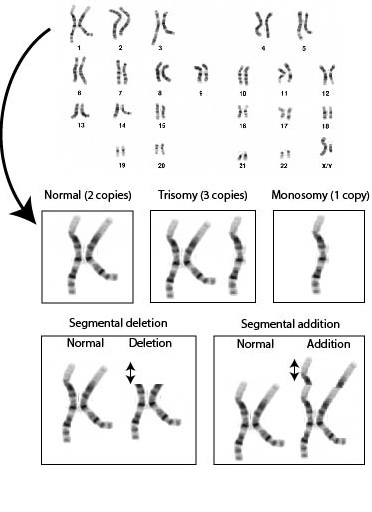
If that doesn’t make sense, I recommend checking my page on understanding PGS testing results.
There are “high” and “low” level mosaics, which refer to the proportion of cells that are aneuploid. In this study, they found that the biggest differences were when mosaics of less than 50% (low level) and greater than 50% (high level) were compared. So they defined low level as <50% aneuploid cells, and high level as >50% aneuploid cells.
For high vs low level mosaics:
- For all mosaics, high level had a 28.4% ongoing pregnancy rate compared to 40.1% for low level.
- For whole chromosome mosaics, high level had a 19.3% ongoing pregnancy rate compared to 36.1% for low level.
- For segmental mosaics, there was no difference in low level vs high level.
For number of affected chromosomes:
- For segmental mosaics, there was no difference in high level vs low level (~42%) but lower than euploid (52.3%)
- For low level whole chromosome, there was no difference until >3 chromosomes affected (52.3% for euploid vs 25.0%)
- For high level whole chromosome, there was no difference (~13-22% vs 52.3% for euploids)
For specific chromosomes, they weren’t able to evaluate this adequately because of the lower sample size for each abnormality. However they state that “blastocyst-stage mosaicism in any of the 23 chromosomes may result in viable pregnancies. “.
From this data they ranked mosaic embryos for their potential to create/maintain a pregnancy, from the highest to lowest:
- Segmental
- Low level (<50% mosaic), one chromosome affected
- Low level, two chromosomes affected
- Low level, complex (>3 chromosomes affected)
- High level (>50% mosaic), one chromosome affected
- High level, two chromosomes affected
- High level, complex
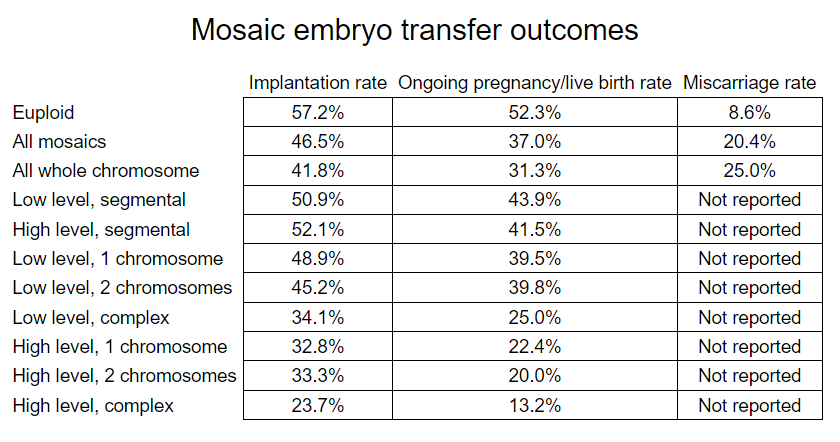
They found no differences between mosaic monosomies or trisomies.
Segmental mosaics performed the best. The authors state that this is probably because these kinds of errors are more easily repaired in the embryo compared to whole chromosome errors.
Mosaics are able to “self-correct” because the healthy cells in the embryo can outgrow the abnormal cells, eventually replacing them. All babies born from these 1000 mosaic transfers have been healthy and not displayed any developmental defects or abnormalities, though long term effects aren’t known. The authors also warn that there has been one reported case of a mosaic embryo leading to a baby with mosaicism, so some caution is needed (Kahraman 2020).
Reference

About Embryoman
Embryoman (Sean Lauber) is a former embryologist and the founder of Remembryo, an IVF research and fertility education website. After working in an IVF lab in the US, he returned to Canada and now focuses on making fertility research more accessible. He holds a Master’s in Immunology and launched Remembryo in 2018 to help patients and professionals make sense of IVF research. Sean shares weekly study updates on Facebook, Instagram, and Reddit regularly. He also answers questions on Reddit or in his private Facebook group.
Related posts:
 Complete guide to PGT-A (PGS testing)
 Complete guide to mosaic embryos
 No difference in euploid and mosaic embryo transfers: a clinical trial
 A look at how PGT-A results change with age, using data from over 86,000 biopsies
 Large study questions the value of reporting mosaic PGT-A results
 Depletion of aneuploid cells in mosaic embryos
 144 “abnormal” (aneuploid/mosaic) embryos and their outcomes
 How PGT-A testing has evolved (1990’s to today)