
Researchers in a 2021 study performed a clinical trial and found that low and moderate level mosaic embryos have comparable pregnancy outcomes to euploid embryo transfers.
Mosaic embryos contain cells that are both aneuploid and euploid and have been shown to have a reduced success rate compared to euploid embryos.
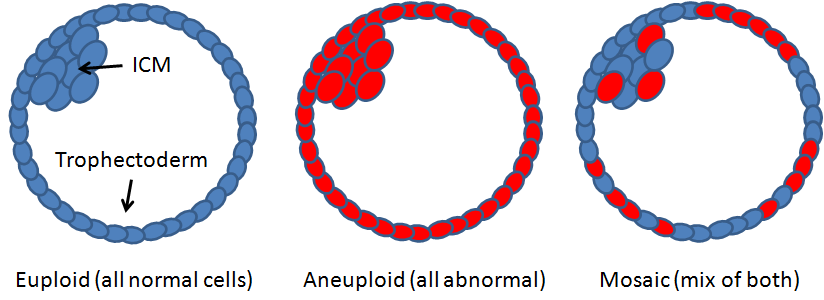
Mosaic embryos are often transferred secondary to euploid embryos. So previous studies that examine the outcomes of mosaic embryo transfers have a selection bias because these women have likely had a failed euploid transfer already.
This study wanted to evaluate mosaic embryos without this selection bias. The euploid/mosaic status of embryos following PGT-A was blinded so all the patients (and doctors) didn’t know whether it was a euploid or mosaic embryo being transferred.
Key points:
- Women were below 45 and used their own eggs
- They had at least one transferrable embryo that was euploid or low/moderate mosaic (low: 20-30% mosaic, moderate: 30-50% mosaic)
- The most frequent reason for PGT-A was advanced maternal age (73.6%) followed by recurrent implantation failure (4.1%) and recurrent pregnancy loss (3.5%).
Check my complete guide to mosaic embryos to learn more about mosaics, or my complete guide to PGT-A to get more background on PGT-A (aka PGS testing).
🔗 Original studies are referenced in this post or within the linked Remembryo posts.
💡 Reminder: Terms underlined with a dotted black line are linked to glossary entries. Clicking these does not count toward your paywall limit.
Results
783 patients participated in this clinical trial consisting of 847 single embryo transfers:
- 484 euploid embryo transfers
- 282 low whole chromosome mosaic (20-30% mosaic) embryo transfers
- 131 moderate whole chromosome mosaic (30-50%) embryo transfers
Live birth rates:
There was no statistical difference in live birth rates between euploid and low/moderate level whole chromosome mosaic embryos.
There were no statistical difference in live birth rates between low and moderate whole chromosome mosaic embryos.
There was no statistical difference between ongoing pregnancy rates, clinical pregnancy rates, biochemical pregnancy rates, multiple pregnancies, or miscarriage rates.
There were no statistical difference in perinatal outcomes, including obstetrical complications, congenital anomalies, neonatal death, gestational period or birth weight.
They did a genetic analysis of the newborns from euploid (11), low level- (18), and moderate level- (9) mosaic transfers and found that all were fully normal. There were no abnormal karyotypes or UPD. One abnormality was observed from the moderate-level mosaic group (Beckwith-Wiedemann Syndrome), however this was due to an error in genomic imprinting not detectable by PGT-A.
By excluding mosaic embryos from transfer, this could lower the cumululative live birth rate. In this study, the cumulative live birth rate is the chance of a live birth from an ovarian stimulation cycle including all subsequent FETs from that cycle.
By excluding mosaic embryo transfers, this lowered the overall cumulative live birth rate 24% and 7% (for low and moderate level mosaics) and up to 36% in their projected theoretical model (with combined low/moderate level mosaic transfers).
Conclusions
This study shows that low/moderate level mosaic embryos have comparable clinical outcomes to euploid embryos in terms of live birth, miscarriage and pregnancy rates. They also found that low/moderate mosaic embryos are not associated with chromosomal abnormalities at birth.
Reference

About Embryoman
Embryoman (Sean Lauber) is a former embryologist and the founder of Remembryo, an IVF research and fertility education website. After working in an IVF lab in the US, he returned to Canada and now focuses on making fertility research more accessible. He holds a Master’s in Immunology and launched Remembryo in 2018 to help patients and professionals make sense of IVF research. Sean shares weekly study updates on Facebook, Instagram, and Reddit regularly. He also answers questions on Reddit or in his private Facebook group.
Related posts:
 Complete guide to PGT-A (PGS testing)
 Complete guide to mosaic embryos
 Ranking 1,000 mosaic embryo transfers
 A look at how PGT-A results change with age, using data from over 86,000 biopsies
 Large study questions the value of reporting mosaic PGT-A results
 Depletion of aneuploid cells in mosaic embryos
 144 “abnormal” (aneuploid/mosaic) embryos and their outcomes
 How PGT-A testing has evolved (1990’s to today)