
Researchers in a 2023 study evaluated factors affecting pregnancy outcomes after euploid transfer, and found that double euploid transfer, BMI, type of FET protocol, and the day of embryo biopsy all had an impact.
A number of factors can influence pregnancy outcomes following euploid embryo transfer. Vidales et al. (2023) wanted to better understand these factors and examined the outcomes of 1,660 frozen embryo transfers between 2016 and 2020 at a clinic in the United Arab Emirates.
For more background information on PGT-A, check out my Complete guide to PGT-A (PGS testing).
🔗 Original studies are referenced in this post or within the linked Remembryo posts.
💡 Reminder: Terms underlined with a dotted black line are linked to glossary entries. Clicking these does not count toward your paywall limit.
Study details
- Patients were on average 33.5 years old.
- Medicated FETs, natural cycle FETs and mild ovarian stimulated FETs were performed.
- Single euploid and double euploid transfers were performed in this study.
In terms of baseline characteristics, there were a number of differences between the groups. They statistically adjusted the data with a multivariate analysis to control for age, BMI, AMH, number of embryos transferred, FET protocol and day of embryo biopsy.
Double euploid transfers increase rates of clinical pregnancy, live birth, multiples and miscarriage
In this study, both single and double euploid transfer took place; for single vs double, the rates of:
- Clinical pregnancy increased (57.7% vs 71.6%, p< 0.001).
- Clinical miscarriage increased (13.9% vs 21.3%, p= 0.003).
- Live birth increased (49.1% vs 55.2%, p= 0.016).
- Live birth with singletons decreased (98.1% vs 46.4%, p< 0.001).
- Live birth with twins increased (1.9% vs 53.0%, p< 0.001).
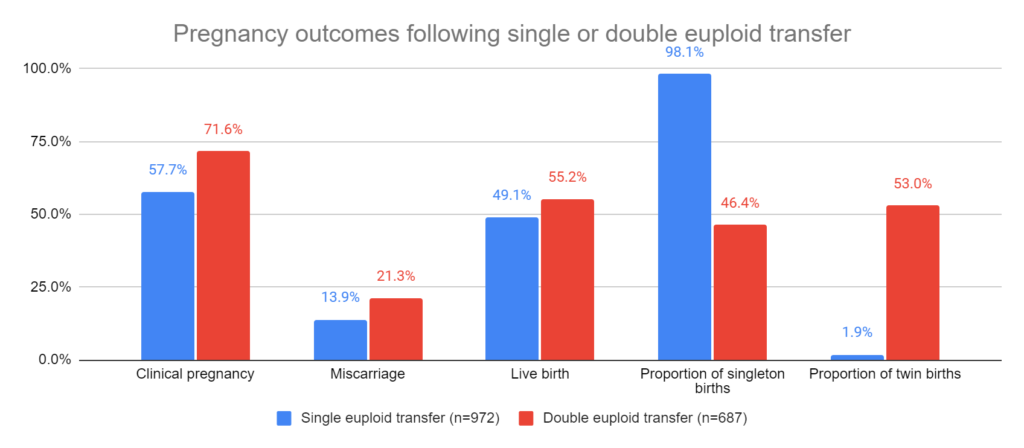
After statistical adjustment, there was an increase in live births for double euploid transfers vs single euploid transfers (odds ratio [95%] CI]: 1.252 [1.017-1.541]).
Age has no influence on pregnancy outcomes after euploid transfer
When the researchers compared pregnancy outcomes after transferring euploid embryos for women <40 and >40, they found no differences for clinical pregnancy (62.9% vs 66.3%), miscarriage (17.5% vs 14.7%) and live birth rate (50.8 vs 55.7%).
BMI influences pregnancy outcomes after euploid transfer
The researchers next compared pregnancy outcomes after transferring euploid embryos in women with BMI <18.5 (underweight), 18.5-24.9 (normal), 25-29.9 (overweight) and >30 (obese). They found no difference in clinical pregnancy rates, but there were differences in miscarriage (p< 0.001) and live birth rates (p= 0.031).
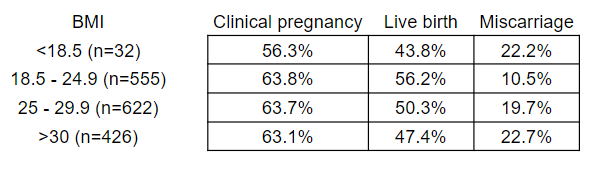
After statistical adjustment, there was an decrease in live births for overweight and obese women (odds ratio [95%] CI]: 0.781 [0.616-0.990]; and 0.691 [0.532-0.898]).
Difference in pregnancy outcomes after euploid transfer based on FET protocol used
Three different FET protocols were used in this study (medicated, natural and mild stimulated), which were found to have no impact on clinical pregnancy rates, but had differences in miscarriage (p< 0.001) and live birth rates (p= 0.001).

After statistical adjustment, there was an increase in live births for natural cycle FET vs medicated FET (odds ratio [95%] CI]: 1.445 [1.160-1.800]).
Pregnancy outcomes decrease in euploids biopsied on day 6 or 7 compared to day 5
Embryos were biopsied on day 5, 6 or 7, which led to a differences in clinical pregnancy (p< 0.001) and live birth rates (p< 0.001). There was no change in miscarriage rates (likely because of the very low sample size for day 7 euploids).
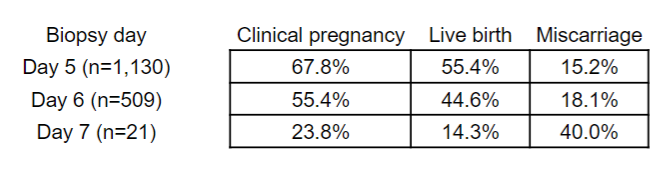
After statistical adjustment, there was a statistically significant decrease in pregnancy rates for embryos biopsied on day 5 vs day 6 (odds ratio [95% CI]: 0.631 [0.504-0.789]) and for day 5 vs day 7 (0.165 [0.059-0.459]). There was also a decrease for live birth rates, but the authors didn’t indicate the values.
AMH levels had no impact on pregnancy outcomes after euploid transfer
The patients in this study had a range of AMH levels (<0.5, 0.5-1.3, 1.3-6.25, >6.25 ng/ml). There were no differences in clinical pregnancy, miscarriage or live birth rates among these different levels.
Conclusions
This study found statistically significant difference in pregnancy, live birth and miscarriage rates after euploid transfer due to a number of factors:
- Double euploid transfers led to increased pregnancy and live birth rates, while also increasing rates of miscarriage and multiples.
- High BMI had a negative effect on euploid pregnancy outcomes.
- Natural cycle FETs had improved outcomes compared to medicated FETs.
- Embryos biopsied on day 5 showed improved outcomes compared to day 6 and day 7 euploids.
- No effect of age or AMH on euploid pregnancy outcomes.
This study goes against the Rieg et al. (2020) study (summarized here) in terms of the impact of age on euploid success rates. The authors of this study note that the Rieg et al. study was larger and there were more older patients included.
Regarding BMI, the authors suggest it may be linked to disruptions in placental and uterine function, as well as endocrine and metabolic disorders in overweight women.
The authors highlight the advantages of using natural cycle FETs, emphasizing that the corpus luteum generates numerous substances, including relaxin and VEGF, that are absent in medicated cycles. Additionally, suboptimal levels of estradiol/progesterone may play a role in the decreased effectiveness of medicated FETs.
Reference

About Embryoman
Embryoman (Sean Lauber) is a former embryologist and the founder of Remembryo, an IVF research and fertility education website. After working in an IVF lab in the US, he returned to Canada and now focuses on making fertility research more accessible. He holds a Master’s in Immunology and launched Remembryo in 2018 to help patients and professionals make sense of IVF research. Sean shares weekly study updates on Facebook, Instagram, and Reddit regularly. He also answers questions on Reddit or in his private Facebook group.