
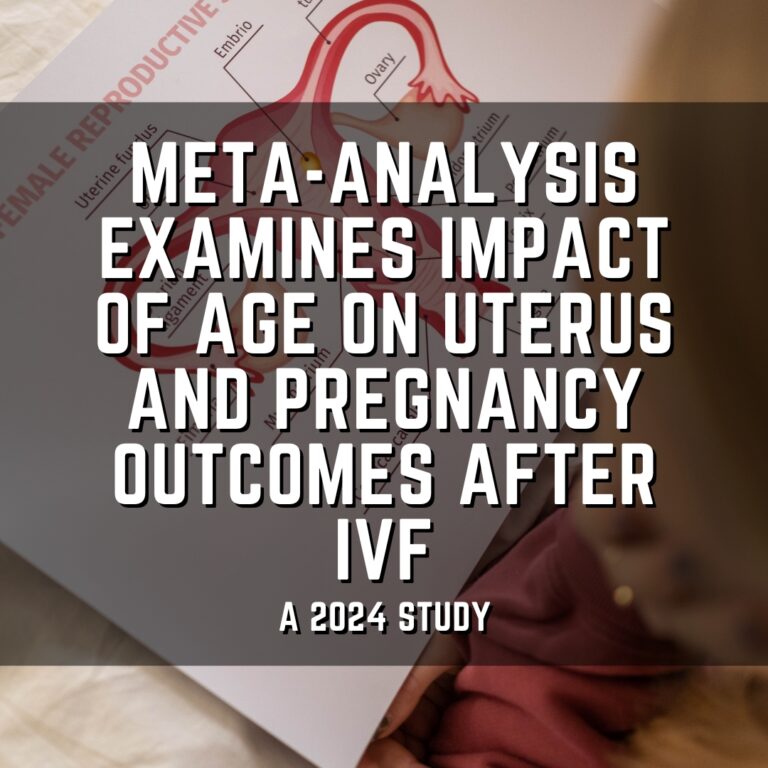
A new study combined the results of 142 studies to investigate how age affects the uterus and pregnancy outcomes after IVF. They identified a number of changes, including decreased endometrial thickness and lower pregnancy rates with age.
While it’s well-known that egg quality decreases with age, the effect of aging on the uterus and endometrium is less clear.
Researchers can study how aging affects the uterus and endometrium by looking at embryo transfers with euploid embryos or donor eggs in older women. Older eggs are more likely to have genetic problems (aneuploidy), which lowers the chances of pregnancy (reviewed in this post). By using euploid embryos or donor eggs, which are less likely to have these issues, the effects of egg quality are mostly removed. This helps researchers focus on how age impacts the uterus and the endometrium.
This post is a summary of a meta-analysis by Marti-Garcia et al. (2024), who combined 142 studies investigating how age affects the uterus and pregnancy outcomes after IVF. All of the studies included in this meta-analysis involved the transfer of either euploid embryos or donor eggs in younger and older women.
🔗 Original studies are referenced in this post or within the linked Remembryo posts.
💡 Reminder: Terms underlined with a dotted black line are linked to glossary entries. Clicking these does not count toward your paywall limit.
Age-related changes in the uterus and its effect on IVF pregnancy outcomes
This part of the study involved a meta-analysis that combined 51 studies exploring how age-related changes in the uterus impact pregnancy outcomes after IVF.
Endometrial thickness. Compared to younger women, the endometrium of older women (aged 35-40) was about 0.52 mm thinner (mean difference [95% CI]: -0.52 mm [-0.72 to -0.32], I2= 76%, 5126 women from 7 studies).
Pregnancy rate. Older women (around age 40) were 0.8 times as likely to get pregnant as younger women (odds ratio [95% CI]: 0.80 [0.69-0.93], I² = 55%, 52,843 embryo transfers from 22 studies).
Live birth rate. No difference in live birth rates for younger women and older women (age 40). Based on data from 10 studies.
Implantation rate. Older women (around age 40) were 0.73 times less likely to have implantation as younger women (odds ratio [95% CI]: 0.73 [0.57-0.93], I2= 75%, 69,384 embryo transfers from 10 studies).
Pregnancy loss. Older women (around age 40) were 1.44 times more likely to have a pregnancy loss as younger women (odds ratio [95% CI]: 1.44 [1.04-1.99], I2= 60%, 20,798 clinical pregnancies from 11 studies).
Other age-related effects on the uterus
Besides the IVF pregnancy outcomes described above, this study also did a systematic review on a number of topics relating to age and the uterus. This part of the study wasn’t a meta-analysis, so no data (numbers) were reported.
- Uterine morphology. Studies show that as women get older, the uterus typically grows larger and changes shape until around menopause, when it starts to shrink. However, findings vary on when it begins to shrink with age, with some noting changes around ages 35-40, after menopause, or after 45. This was based on a review of 12 studies.
- Uterine vasculature. Several studies found that as women age, uterine blood flow decreases and the structure of blood vessels worsens. Some studies also observed mineral buildup in the arteries of older women, which may lead to blood vessel stiffness and hinder proper vascularization. However, the impact of aging on the function of these blood vessels varied across studies. This was based on a review of 17 studies.
- Endometrial histology. Studies on aging and endometrial health generally show no significant changes when using standard evaluation criteria, but specialized studies have found age-related declines in glandular tissues, particularly in women over 37. Glandular tissue in the endometrium produces secretions that are essential for nourishing and supporting an embryo during early pregnancy. Postmenopausal women also show a decrease in certain types of cells within the endometrium, indicating that aging impacts the cellular structure of this tissue. This was based on a review of 10 studies.
- Menstrual cycle characteristics. Studies show that age negatively impacts hormone levels associated with ovarian function, leading to lower levels of hormones like estrogen and progesterone, especially in menopausal women. Additionally, age affects menstrual cycle characteristics, often resulting in irregular cycles and changes in cycle phases, though findings on specific phase lengths vary among studies. This was based on a review of 18 studies.
- Biomolecules. Studies show that as women age, key proteins involved in cell proliferation and adhesion decrease, which can affect how well the uterus and endometrial function. Advanced testing methods also reveal changes in gene expression with increased age, making the uterus more vulnerable to SARS-CoV-2 infections, along with decreased diversity of the uterine microbiome. This was based on a review of 14 studies.
Conclusion
This meta-analysis found a number of changes with older female age that can be attributed to the uterus:
- Decreased endometrial thickness.
- Lower pregnancy rates but no significant change in live birth rates.
- Higher pregnancy loss rates.
- Reduced uterine blood flow and worsened blood vessel structure, with potential mineral buildup in uterine arteries.
- Changes in the cellular makeup of the endometrium, hormone levels, endometrial gene expression and menstrual cycle characteristics.
- Decreased diversity of the uterine microbiome.
The authors explain that older women show hormonal changes, like reduced estrogen and higher FSH, that can disrupt the development of the uterine lining and make it thinner and less receptive to embryo implantation. A thinner endometrium might also be related to compromised blood vessel structure and reduced blood flow, which can alter endometrial receptivity.
Some studies suggest that older women have more ciliated cells in the endometrium. These cells help the embryo move along the surface, and having too many might prevent the embryo from implanting properly.
Aging also affects the uterine microbiome, reducing its balance and diversity, which might affect IVF success. To read more about this topic, check out my post The impact of the vaginal and endometrial microbiome on reproductive health and IVF outcomes.
This meta-analysis had some limitations, including a large amount of variability (heterogeneity) in the studies that were included. There’s also a lack of higher quality data (RCTs) on this topic.
Previous reviews on the topic have generally found no clear impact of age on reproductive outcomes, which might be related to sample size or confounding factors, the authors write.
I’ve covered several studies that have looked at the impact of maternal age on success rates when transferring a euploid embryo:
- Euploid embryos show reduced implantation potential with advancing maternal age — this is the largest study to date on the topic, which found that women who did a euploid transfer at an older age had lower live birth rates compared to younger women.
- Study finds that female age doesn’t impact euploid embryo transfer success rates — this study compared successful and unsuccessful euploid transfers, finding that female age had no impact, while BMI, embryo quality and the type of FET used did.
- Study evaluates factors affecting pregnancy outcomes after euploid transfer — this study found no differences in pregnancy outcomes after transferring euploid embryos in women <40 and >40. They also looked at BMI, FET protocol, the day the embryo was biopsied, and AMH levels.
- Meta-analysis combines 74 studies to examine factors linked to euploid transfer success — this study found a slight influence in female age at time of retrieval and euploid success rates. They also compared a large number of other factors, like embryo quality, BMI, diagnosis, type of assisted hatching and more.
Related studies
To learn more about this topic, you can check out a number of studies referenced in this study below (9 links):

Reference

About Embryoman
Embryoman (Sean Lauber) is a former embryologist and the founder of Remembryo, an IVF research and fertility education website. After working in an IVF lab in the US, he returned to Canada and now focuses on making fertility research more accessible. He holds a Master’s in Immunology and launched Remembryo in 2018 to help patients and professionals make sense of IVF research. Sean shares weekly study updates on Facebook, Instagram, and Reddit regularly. He also answers questions on Reddit or in his private Facebook group.
Related posts:
 Egg freezing and thawing
 Comparing frozen embryo transfer/FET protocols
 Sleep quality and its impact on IVF outcomes
 Study finds poor ovarian responders have no further live births after 4 cycles
 Identifying the optimal timing for embryo transfer in modified natural and natural FETs
 Euploid embryos show reduced implantation potential with advancing maternal age
 Examining live birth rates in IVF cycles with 5 or less follicles
 Study compares outcomes after first IVF cycle, based on age