
Researchers in a 2023 study compared fertility outcomes in women trying to conceive who took myo-inositol, probiotic and micronutrient supplements and found no improvements in clinical pregnancy and live birth rates, with contrasting outcomes in time-to-conception based on BMI.
Supplements like myo-inositol or probiotics are often taken in an attempt to improve fertility, but how well they work isn’t clear.
Check my post on improving egg quality with supplements for more information, or for more background on egg quality, check out my Complete guide to egg quality.
Chan et al. (2023), in their randomized controlled trial (RCT), evaluated the fertility benefit of supplementing myo-inositol, probiotics and micronutrients among women who were planning to conceive spontaneously (without fertility treatment).
This was a secondary aim of the Nutritional Intervention Preconception and During Pregnancy to Maintain Healthy Glucose Metabolism and Offspring Health (NiPPeR) international trial that took place between 2015 and 2017 and involved participants from the UK, New Zealand and Singapore. The primary aim for this study was gestational glycemia at 28 weeks gestation, which showed no difference.
In this trial, there were a total of 1,437 women, with 701 control women and 736 test women who were given a supplement drink twice a day while they were attempting to conceive spontaneously over the course of a year. The supplement drinks contained:
- Control: folic acid (400 ug/day), iron (12 mg/day), calcium (150 mg/day), iodine (150 ug/day) and beta-carotene (720 ug/day).
- Test: same as control plus myo-inositol (4 g/day), vitamin D (10 ug/day), riboflavin (1.8 mg/day), vitamin B6 (2.6 mg/day), vitamin B12 (5.2 ug/day), zinc (10 mg/day) and probiotics (Lactobacillus rhamnosus and Bifidobacterium animalis sp. lactis).
Key information:
- This study included a number of ethnicities, such as White, Chinese, South Asian and Malays.
- Only 6.4% of women in this study had PCOS-like features.
- The women included in this study were 18-38 years old who were planning to conceive.
- Women were excluded if they were undergoing fertility treatment, along with other exclusions.
- Participation in this trial ended if a woman didn’t become pregnant after 1 year.
- This study used “time-to-conception” as a metric for fertility, measured as the number of days it took 20% of women to have a clinical pregnancy (by ultrasound at 6 weeks).
Baseline characteristics were similar between the groups.
🔗 Original studies are referenced in this post or within the linked Remembryo posts.
💡 Reminder: Terms underlined with a dotted black line are linked to glossary entries. Clicking these does not count toward your paywall limit.
No difference in time-to-conception when taking myo-inositol, probiotics and micronutrients
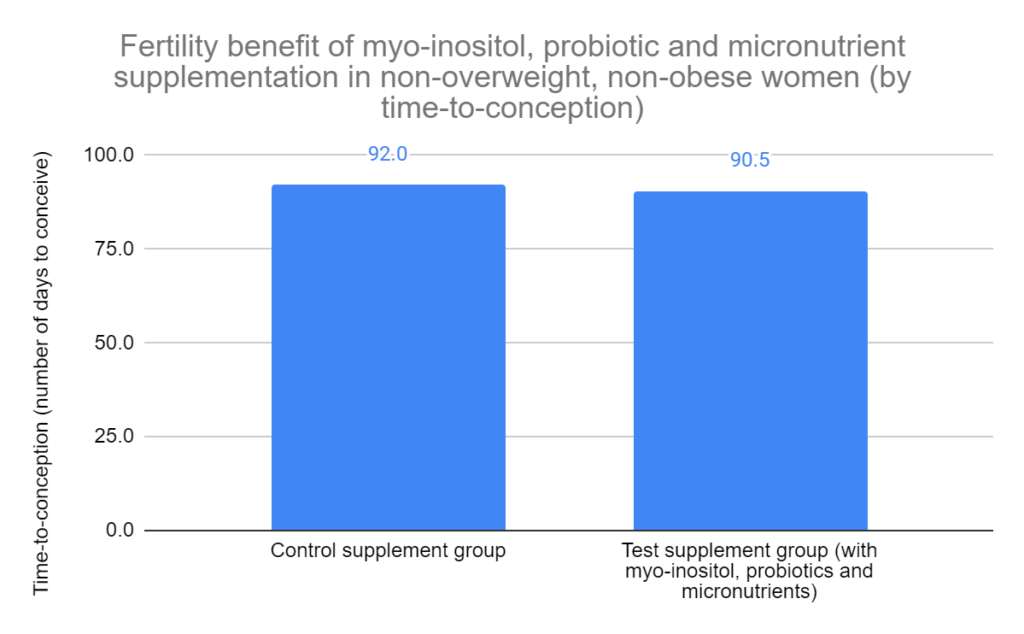
In their total cohort, there was no difference in the time-to-conception for the control group and the test group who supplemented myo-inositol, probiotics and micronutrients (92.0 days vs 90.5 days).
No difference in clinical pregnancy or live birth rates when taking myo-inositol, probiotics or micronutrients
They also compared clinical pregnancy rates at 3, 6 and 12 months since beginning the study.
Comparing controls to the test group, there were no differences in the daily pregnancy rates over 3 months (0.23% vs 0.25%), 6 months (0.22% vs 0.22%) or 12 months (0.20% vs 0.20%). By the end of the year, about 50% of the participants were pregnant from both groups.
There were still no differences after statistically adjusting for the research site and ethnicity, or for age, BMI and gravidity (the number of times a woman has historically been pregnant). Sensitivity analyses also showed no differences when they reanalyzed the data and excluded people with fertility issues, those who didn’t conceive after a year and those with lower adherence.
This shows that a number of suspected factors had no influence on pregnancy rates in these women, and myo-inositol, probiotics and micronutrients are unlikely to have any impact on pregnancy rates in these women.
There were also no differences in live birth rates (hazard ratio [95% CI]: 0.94 [0.79-1.11]; the researchers didn’t indicate the specific rates).
Overweight women had shorter time-to-conception when taking myo-inositol, probiotics and micronutrients, while obese women had a longer time-to-conception
In another analysis, the researchers compared time-to-conception for overweight and obese women.
Time-to-conception was similar for control and test women who weren’t overweight or obese.
However, for overweight test women there was a reduction in time-to-conception compared to the control (117.0 days vs 84.5 days, hazard ratio [95% CI]: 1.47 [1.07-2.02])). This means that the time-to-conception of control women was 1.47 times the time-to-conception of test women after a year (or 47% higher).
On the other hand, control women who were obese had a lower time-to-conception compared to test women (108.5 days vs 132.7 days, hazard ratio [95% CI]: 0.69 [0.47-1.00]). This means that the time-to-conception of control women was 0.69 times the time-to-conception of test women after a year (or 31% lower).
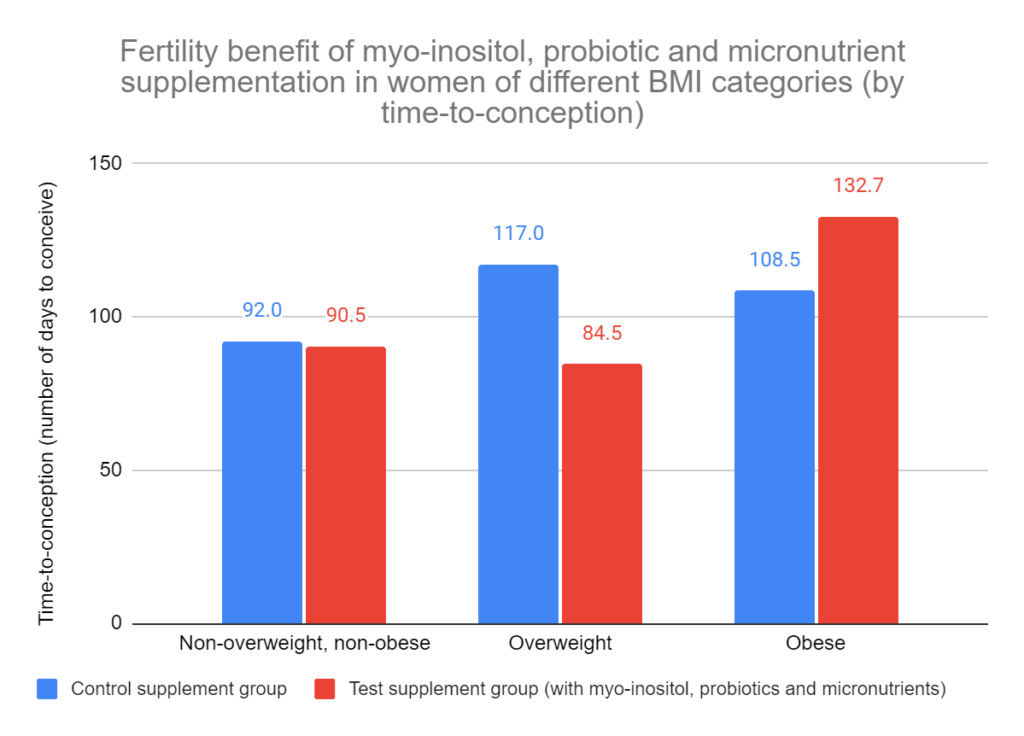
Upon further investigation, the researchers found that only non-White obese women had a decrease in time-to-conception (131.0 days in the control, while only 14.1% conceived in the test group, which was lower than the 20% used to measure time-to-conception; hazard ratio [95% CI]: 0.38 [0.20-0.72]). This means that the time-to-conception of the control women was 0.38 times the time-to-conception of test women after a year (or 62% lower).
Conclusions
This study found that there was no overall fertility benefit for women taking myo-inositol, probiotics and micronutrients in terms of time-to-conception, clinical pregnancy and live birth rates.
When researchers compared different BMI categories, they found a benefit for overweight women who took these supplements, with a reduction in their time-to-conception. However, this was not the case for non-White obese women, who had an increase in their time-to-conception.
The authors explain that the benefit for overweight women may be attributed to a reduction in inflammation (indicated by lower C-reactive protein levels in this group), which may improve implantation and the chance of conception.
For non-White obese women who had an increased time-to-conception, the mechanism isn’t clear but may be related to elevated HbA1c baseline levels (heightened blood sugar) in this group.
It’s not clear what component of their supplement cocktail had these effects, although this wasn’t the primary intention of this trial. A number of supplements are often taken when trying to conceive and this study highlights that different groups may experience different outcomes, so it’s important to take supplements under the guidance of your doctor. Furthermore, more well-designed studies are needed that examine supplements in specific populations to understand who benefits and who doesn’t.
Reference

About Embryoman
Embryoman (Sean Lauber) is a former embryologist and the founder of Remembryo, an IVF research and fertility education website. After working in an IVF lab in the US, he returned to Canada and now focuses on making fertility research more accessible. He holds a Master’s in Immunology and launched Remembryo in 2018 to help patients and professionals make sense of IVF research. Sean shares weekly study updates on Facebook, Instagram, and Reddit regularly. He also answers questions on Reddit or in his private Facebook group.
Related posts:
 Complete guide to egg quality
 Impact of supplements on live birth and pregnancy rates in women: a meta-analysis
 Mediterranean diet and IVF – a clinical trial
 Oocyte quality and IVF outcomes linked to maternal lifestyle and diet
 Sleep quality and its impact on IVF outcomes
 Endocrine disruptors and their impact on fertility
 Study evaluates interventions that lower endocrine disruptor levels
 Study examines impact of increasing BMI on euploid transfer outcomes