

Researchers in a 2023 study found that probiotic supplementation had no impact on positive hCG pregnancy rates, but may improve miscarriage rates.
The vaginal microbiome has been linked to IVF outcomes, and some data has shown that probiotics containing Lactobacillus can improve these outcomes.
Thanaboonyawat et al. (2023) investigated embryo transfer outcomes after supplementing a Lactobacillus probiotic. A total of 158 women were given the probiotic, and 158 weren’t. This was a randomized controlled trial that took place between 2019 and 2021 at a hospital-based IVF center in Thailand.
Key information:
- Women were excluded if they had recurrent implantation failure (failure of implantation after 3 transfers of good quality embryos) or had endometrial thickness <7 mm.
- Women were 18-39 years old.
- Women received a tablet of Gynoflor (containing 100 million cfu of Lactobacillus acidophilus KS400 bacteria and 0.03 mg of estriol) daily for 6 days, starting on the day of luteal phase support in a medicated frozen embryo transfer (when progesterone starts).
- One or two good quality day 3 or day 5 embryos were used in a frozen embryo transfer. Good quality day 3 embryos had 6 or more cells and <10% fragmentation, while good quality blastocysts had a grade 4BB or higher.
- Miscarriage included both biochemical and clinical pregnancy losses before 20 weeks.
- The primary outcome was the positive hCG pregnancy rate. This refers to a positive hCG pregnancy test.
- The secondary outcomes were the implantation rate, miscarriage rate, clinical and ongoing pregnancy rate and live birth rate.
In terms of baseline characteristics, for the probiotic group vs the control group, there were no differences in age (35.10 vs 35.51), gravida, parity, previous abortion, infertility duration, number of previous transfers, day of endometrial preparation, endometrial thickness (9.56 vs 9.56), cleavage stage embryo transfer (37.97% vs 31.65%), blastocyst stage embryo transfer (62.03% vs 68.35%), number of embryos transferred (1.68 vs 1.66), bacterial vaginosis (16.46% vs 14.56%), fungus detected in discharge and infertility diagnosis (the majority of cases were male factor, pelvic endometriosis, tubal and pelvic, and endometriotic cyst).
For more information on the microbiome, check out my post The impact of the vaginal and endometrial microbiome on reproductive health and IVF outcomes.
🔗 Original studies are referenced in this post or within the linked Remembryo posts.
💡 Reminder: Terms underlined with a dotted black line are linked to glossary entries. Clicking these does not count toward your paywall limit.
Primary outcome: No difference in positive hCG pregnancy rates with Lactobacillus acidophilus probiotic
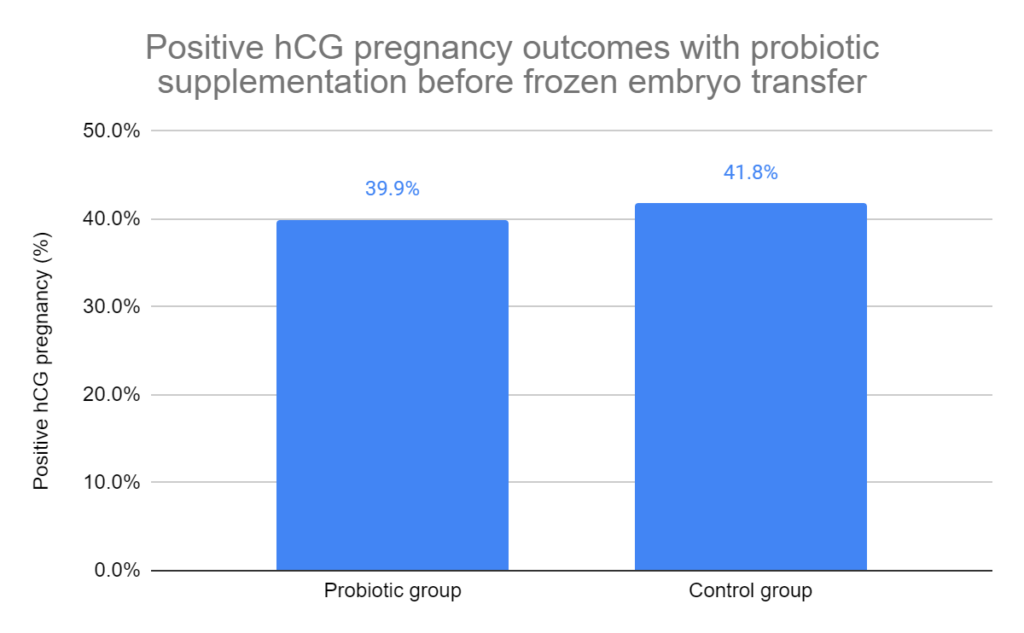
This RCT was designed to find a statistically significant difference in positive hCG pregnancy rates. For the probiotic vs the control group, they found no difference in positive hCG pregnancy rates (39.9% vs 41.8%; odds ratio [95% CI]: 0.92 [0.59-1.45]).
Secondary outcomes: Decrease in miscarriage rates with Lactobacillus acidophilus probiotic
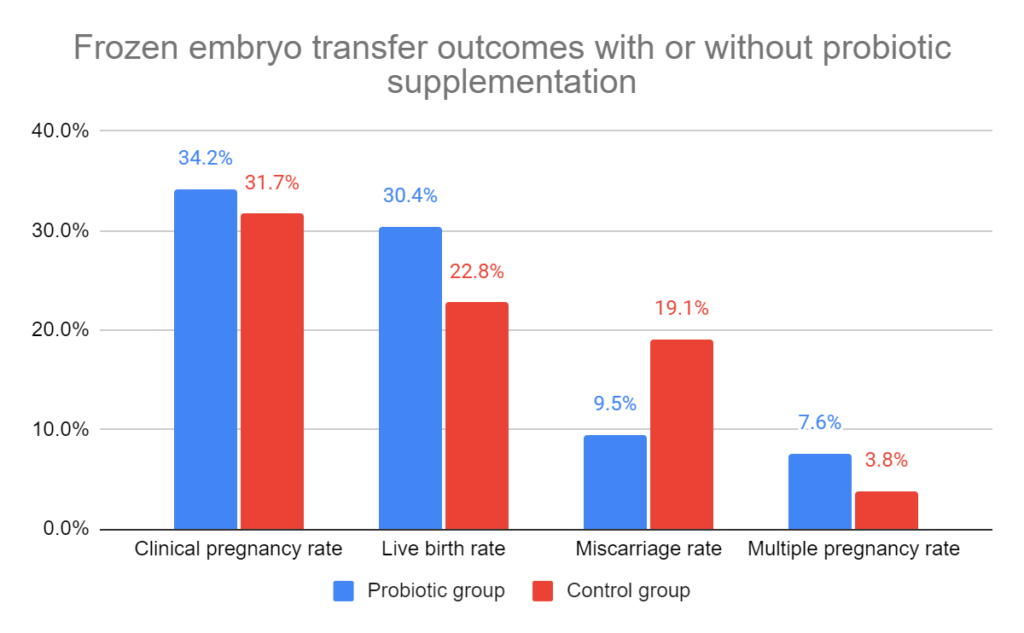
For their secondary outcomes, there was no statistically significant difference in the rates for implantation, clinical pregnancies, ongoing pregnancies, live births, ectopic pregnancies and multiple pregnancies. There was a 56% decrease in the miscarriage rate, which was statistically significant (9.5% vs 19.1%; odds ratio [95% CI]: 0.44 [0.23-0.86]).
Subgroup analysis finds improved live birth and miscarriage rates in blastocyst group, not cleavage stage embryo group
This study included women who transferred day 3 cleavage stage embryos, or day 5 blastocysts. A subgroup analysis was performed to separate these groups so they could be analyzed independently.
For day 3 cleavage stage embryo transfers, there were 60 women in the probiotic group and 50 women in the control group. They found no differences in any of the outcomes examined.
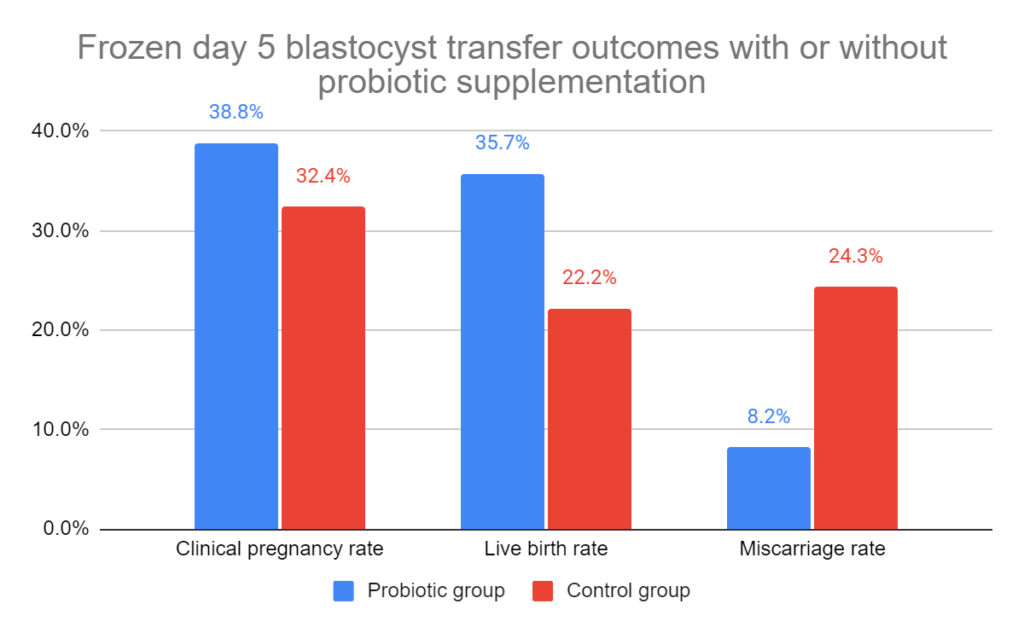
For day 5 blastocyst transfers, there were 98 women in the supplement group and 108 women in the control group. They found no statistically significant differences in positive hCG pregnancies, clinical pregnancies and ongoing pregnancies. They found a statistically significant improvement in those using the probiotic for live birth and miscarriage rates (35.7% vs 22.2%, p= 0.03; 8.2% vs 24.3%, p= 0.002).
They also performed a subgroup analysis on women with bacterial vaginosis and on women with vaginal candidiasis, which showed no statistically significant differences between the probiotic and control groups.
Conclusions
This study found no statistically significant differences in positive hCG pregnancy rates (their primary outcome), but found improvements in miscarriage rates with the probiotic.
In a subgroup analysis, they found that the day 5 embryo transfer group had better live birth rates and miscarriage rates when the probiotic was used, but there were no differences with the day 3 embryo transfer group.
The day 5 embryo transfer group would have taken the probiotic for 6 days before transfer, compared to 4 days for the day 3 embryo transfer. The authors state that this increased duration may have led to the improved outcomes by shifting the microbiome to become Lactobacillus-dominant.
More research is needed to confirm these findings using day 5 embryo transfers.
“We found no effect of intravaginal Lactobacilli supplementation in the general IVF population, on [positive hCG pregnancies], clinical, ongoing pregnancy rate, implantation rate, and live birth rate. However, the intravaginal probiotic supplementation significantly reduced the miscarriage rate and increased the live birth rate in patients who received blastocyst transfer.”
Thanaboonyawat et al. (2023)
Reference

About Embryoman
Embryoman (Sean Lauber) is a former embryologist and the founder of Remembryo, an IVF research and fertility education website. After working in an IVF lab in the US, he returned to Canada and now focuses on making fertility research more accessible. He holds a Master’s in Immunology and launched Remembryo in 2018 to help patients and professionals make sense of IVF research. Sean shares weekly study updates on Facebook, Instagram, and Reddit regularly. He also answers questions on Reddit or in his private Facebook group.
Related posts:
 The impact of the vaginal and endometrial microbiome on reproductive health and IVF outcomes
 Why do embryos in IVF fail to implant or miscarry?
 Study investigates the use of EMMA & ALICE in IVF patients with RIF, RPL
 Silent insulin resistance is common, linked to lower IVF success rates
 Complete Guide to Embryo Grading and Success Rates
 How many failed embryo transfers is too many?
 RCT finds no change in birth rates for standard or ERA-timed euploid transfer
 “True” recurrent implantation failure is rare after five consecutive euploid embryo transfers