
A 2024 meta-analysis combined the results of 20 studies, showing that supplements improved IVF outcomes in women with ovarian aging, especially CoQ10.
Ovarian aging refers to the decline in the number and quality of a woman’s eggs as she ages. In younger women, this can cause diminished ovarian reserve or premature ovarian insufficiency that can lead to fertility problems.
This post reviews a recent meta-analysis by Shang et al. 2024, which combined the results of 20 randomized controlled trials (high quality studies) that investigated the use of antioxidant supplements in women with ovarian aging. Ovarian aging generally referred to women over 35 years old and/or women with diminished ovarian reserve (DOR), including some younger women with DOR.
This study is geared more for patients with DOR or POI, and for a look at the general population, check out the latest Cochrane review in my post Impact of supplements on live birth and pregnancy rates in women: a meta-analysis. I also provide more general/background information in my post Improving egg quality with supplements.
🔗 Original studies are referenced in this post or within the linked Remembryo posts.
💡 Reminder: Terms underlined with a dotted black line have glossary definitions. Hover or tap to see a short definition, or select “Read full definition” in the pop-up to view the complete glossary entry. Viewing glossary entries does not count toward your paywall limit.
Study details
This meta-analysis combined multiple studies that involved different supplements and dosages:
Coenzyme Q10 (CoQ10) (30 mg/d, 200 mg/d, 250 mg/d, 600 mg/d, and 1200 mg/d)
- Bentov et al. 2014
- Caballero et al. 2016
- Taylor et al. 2018
- Xu et al. 2018
- Liang 2019
- Zhang et al. 2019
- Jin et al. 2020
Melatonin (2–8 mg/d, 16 mg/d)
- Rizzo et al. 2010
- Valeri et al. 2015
- Jahromi et al. 2017
- Fernando et al. 2018
- Espino et al. 2019
- Wang et al. 2022
Myo-inositol (4 g/d)
- Schillaci et al. 2012
- Nazari et al. 2020
- Mohammadi et al. 2021
Vitamins: Vitamin B (7.8 g/d); Vitamin D (50 mg/d, 600000 IU); Vitamin E (400 units/d, 0.2 g/d)
- Bezerra Espinola et al. 2021
- Gerli et al. 2021
- Somigliana et al. 2021
- Safiyeh et al. 2021
- Gerli et al. 2021 (added Resveratrol 150 mg/d)
Combined antioxidants: Acetyl-L-carnitine, N-acetyl-L-cysteine, and α-lipoic acid (no dosage given)
- Gardner et al. 2020
Clinical pregnancy rates improve with antioxidants
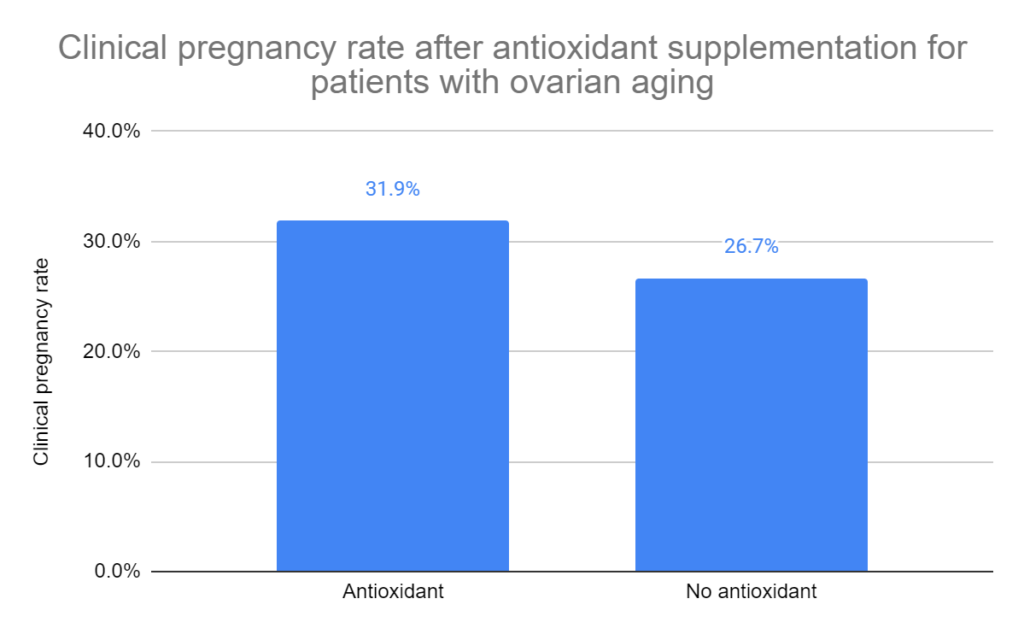
This meta-analysis found an increase in clinical pregnancy rates for patients who used antioxidant supplements vs those who didn’t (31.9% vs 26.7%, odds ratio [95% CI]: 1.55 [1.18-2.04]; 20 RCTs, 2218 patients; I2= 29%; moderate quality of evidence).
They found no difference in live birth rates (7 RCTs, 1224 patients, I2= 0%, low quality of evidence).
There was also no difference in miscarriage rate (8 RCTs, I2= 0%, moderate quality of evidence)
Antioxidant supplements improve IVF outcomes
Patients with DOI or POI tend to have fewer eggs retrieved. This meta-analysis found that supplementing with antioxidants led to an increase of 0.98 eggs retrieved vs those who didn’t supplement (odds ratio [95% CI]: 0.98 [0.52-1.44]; 13 RCTs, 1734 patients, I2= 69%; moderate quality of evidence).
There was no difference in the number of mature eggs retrieved (10 RCTs, 1523 patients, I2= 93%; very low quality evidence).
There was an increase of 0.47 high quality embryo obtained for women supplementing with antioxidants vs those who didn’t supplement (odds ratio [95% CI]: 0.47 [0.16-0.77]; 12 RCTs, 1939 patients, I2= 79%; moderate quality of evidence). Another analysis showed that there was also an increase in the rate of high quality embryos.
Antioxidant supplements didn’t increase the chance of adverse pregnancy outcomes (low birth weight, preterm birth, congenital missing kidney) or minor side effects (headaches, dizziness, nausea or vomiting).
CoQ10 shows the most benefit for patients
This meta-analysis combined the results from 20 different studies, involving different supplements like CoQ10 or melatonin. So far, we’ve seen the results from combining all these studies and all these supplements. Next, the researchers broke it up a bit and grouped these different supplements to see which one had a benefit (note the definitions above on what’s included in “vitamins” and “combined antioxidants”).
- For clinical pregnancy rate, patients taking CoQ10 had a 2.22 times greater odds of pregnancy compared to those not taking it (6 RCTs, 666 patients, I2= 0%). Melatonin, myo-inositol, vitamins and combined antioxidants showed no benefit.
- For number of retrieved eggs, patients taking CoQ10 retrieved an average of 1.51 more eggs. No increase for melatonin and myo-inositol.
- For number of high quality embryos, patients taking CoQ10 had an average of 0.62 more embryos and 0.64 embryos for those taking melatonin. No increase for vitamins.
This data showed that CoQ10 had the most benefit, so next they looked at studies that had different dosages and treatment durations to see which had the most benefit:
- Of the different dosages (30, 600 or 1200 mg/d), only 30 mg/d showed an increase in pregnancy rates (odds ratio [95% CI]: 2.76 [1.78-4.28]; 3 RCTs, 363 patients, I2= 0%).
- Of the different treatment durations (2 or 3 months before IVF), only 3 months showed an increase in pregnancy rates (odds ratio [95% CI]: 2.54 [1.68-3.84]; 4 RCTs, 441 patients, I2= 0%).
This shows that 30 mg/d of CoQ10 for 3 months before IVF resulted in an increased chance of pregnancy. For melatonin, they found an increase in the number of high quality embryos, but only for dosages <5 mg/d, with women taking it during ovarian stimulation or 1 month before having a benefit. This suggests that lower doses of CoQ10 and melatonin showed better outcomes compared to higher doses.
Another analysis showed that treatment duration and the type of antioxidant were the most important factors in predicting positive IVF outcomes (number of eggs retrieved and high quality embryos). This highlights the importance of selecting the appropriate antioxidant type and optimizing treatment duration to enhance IVF outcomes in women with ovarian aging.
Conclusions
This meta-analysis combined the results of 20 RCTs that investigated the use of antioxidant supplements in women with ovarian aging. These supplements mainly included CoQ10, melatonin, myo-inositol and various vitamins.
Overall, women that used supplements showed a benefit in clinical pregnancy rates, but not live birth or miscarriage rates. They also found an increase in the number of eggs retrieved and number of high quality embryos.
When they looked at the individual supplements, they only found a benefit with CoQ10 on pregnancy rates and the number of eggs retrieved, and only in patients who took a low dose for at least 3 months.
Melatonin increased the number of high quality embryos, but only at the lowest dose and at 1 month or less.
The researchers note that the quality of evidence was low in some cases, with substantial variability in the results (heterogeneity) and small sample sizes. Larger and better designed studies are needed to draw conclusions on the benefit of antioxidants for women with ovarian aging.
The study reviewed here was for patients with DOR or POI, and for a look at the general population, check out the latest Cochrane review in my post Impact of supplements on live birth and pregnancy rates in women: a meta-analysis. I also provide more general/background information in my post Improving egg quality with supplements.
Reference

About Embryoman
Embryoman (Sean Lauber) is a former embryologist and the founder of Remembryo, an IVF research and fertility education website. After working in an IVF lab in the US, he returned to Canada and now focuses on making fertility research more accessible. He holds a Master’s in Immunology and launched Remembryo in 2018 to help patients and professionals make sense of IVF research. Sean shares weekly study updates on Facebook, Instagram, and Reddit regularly. He also answers questions on Reddit or in his private Facebook group.