
This post looks at the miscarriage rates of euploids, mosaics and aneuploids by PGT-A in various studies. This is current as of 2022.
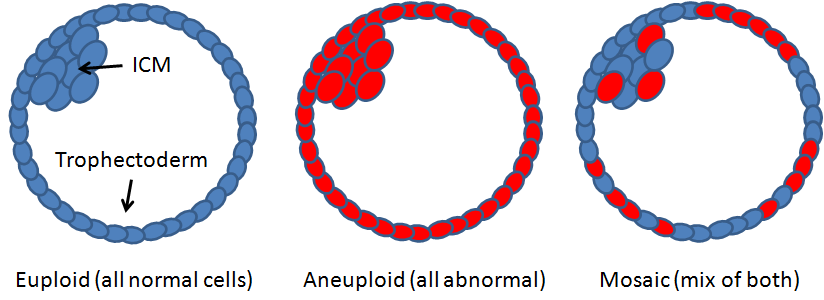
PGT-A (formerly PGS testing) is a technique that determines the number of chromosomes in the cells of an embryo. Normally, we have 23 pairs of chromosomes (or 46 in total) – one pair comes from the egg from our biological mother, and the other comes from the sperm from our biological father.

To do PGT-A, a sample of cells (a biopsy) is taken from the embryo and is submitted for DNA testing in a separate lab. The results come back as euploid (meaning there’s 46 chromosomes), aneuploid (meaning there’s a number of chromosomes besides 46) or mosaic (meaning there’s a mix of euploid and aneuploid cells).
Euploid embryos are believed to have higher success rates and a reduced chance of miscarriage. This is important because miscarriage rates with advancing female age. See the chart below from the CDC (2016 data):

In this post we’ll look at the different miscarriage rates that all these types of PGT-A tested embryos have. We’ll start with euploids, then mosaics, and end with fully aneuploid embryos. Miscarriage is defined as a loss between clinical pregnancy (detection of a gestational sac or heartbeat) and 20 weeks of gestation.
Check my complete guide to mosaic embryos to learn more about mosaics, or my complete guide to PGT-A to get more background on PGT-A (aka PGS testing).
🔗 Original studies are referenced in this post or within the linked Remembryo posts.
💡 Reminder: Terms underlined with a dotted black line are linked to glossary entries. Clicking these does not count toward your paywall limit.
Euploid miscarriage rates
A 2019 multicenter and international RCT (the “STAR” trial) compared euploid and untested embryo transfers. This study is considered the best quality evidence currently available for PGT-A (which showed no benefit over traditional grading for women <35 that you read about that here).
- Overall there was no statistical difference in miscarriage rates (9.9% in the PGT-A group vs 9.6% in the untested group).
- For women <35 years old, there was no statistical difference (11.2% for PGT-A vs 8.3% for untested).
- For women 35-40 years old, there was no statistical difference (8.2% for PGT-A vs 11.0% for untested).
A recent meta-analysis by Simopoulou et al. (2021) compared miscarriage rates across 7 studies and found an overall reduction in PGT-A tested embryos that was significant (10.1% for PGT-A vs 19.6% for untested, risk ratio 0.45, 95% CI [0.25 – 0.80]).
They also did a subgroup analysis using this data for age groups <35 and >35. There was a greater reduction in the >35 group (10.4% for PGT-A vs 27.9% for untested) compared to the <35 group (13.3% for PGT-A vs 16.1% for untested), however neither of these analyses were statistically significant. According to the authors, the >35 group analysis should be “interpreted with caution” as the sample size was small.
Some of the issues with the studies included in the meta-analysis were brought up:
- Most of the patients in the studies were <35. PGT-A is generally recommended for women >35, and the majority of cycles in the US in 2020 were for women >35 (62%).
- The majority of these studies used double embryo transfers, either when transferring euploid embryos, in the control untested groups, or both.
Future studies should focus on single embryo transfers, and in women >35, to see if PGT-A truly has a reduction in miscarriage rates for this age group.
Next let’s look at how mosaics perform in terms of miscarriage (often using euploids as a control – so for you euploid people out there, you might want to check the next section also!).
Mosaics and miscarriage rates
Mosaics are embryos that have a mix of euploid and aneuploid cells. PGT-A is able to evaluate the % of cells that are abnormal in a biopsy sample and if there’s a mix of euploid and aneuploid cells then the embryo is a mosaic.
Mosaics are often transferred after euploid embryos have been exhausted, although there is evidence that low level mosaic transfers are comparable to euploid transfers.
So what about miscarriage rates?
Capalbo et al. (2021) in their multicenter prospective trial transferred 484 euploid, 282 low mosaic (where 20-30% of the cells are aneuploid) and 131 moderate mosaic (30-50%) embryos. Note that this paper is still preprint as of Nov 2021. They found that:
- Euploids had a miscarriage rate of 12.0%
- Low mosaics had a miscarriage rate of 11.0%
- Moderate mosaics had a miscarriage rate of 12.7%
- None of these were statistically significant from the other (adjusted OR [95% CI]: 0.89 [0.50 – 1.55])
If you want to read my summary of this paper, check here.
Viotti et al. (2021) in their retrospective multicenter study compared the transfer of 1000 mosaic embryos and over 5500 euploid embryos between 2015 and 2020.
- Euploid embryos had an 8.6% miscarriage rate
- All of the mosaics had a 20.4% miscarriage rate
But wait! They stratified the mosaics based on the specific type of abnormality, and whether they were <50% mosaic or >50% mosaic (meaning the mosaic embryos had a mix of either less or more than 50% aneuploid cells with euploid cells). If you’re confused about the terminology you’ll see coming up, check my post on understanding PGS testing results.
- Euploid embryos had a 8.6% chance of miscarriage
- <50% mosaic segmental embryos had a 13.6% chance of miscarriage
- >50% mosaic segmental embryos had a 20.3% chance of miscarriage
- <50% one whole chromosome mosaics had a 19.2% chance of miscarriage
- <50% two whole chromosome mosaics had a 11.9% chance of miscarriage
- <50% complex (>2 whole chromosomes) mosaics had a 26.7% chance of miscarriage
- >50% one whole chromosome mosaics had a 31.7% chance of miscarriage
- >50% two whole chromosome mosaics had a 39.9% chance of miscarriage
- >50% complex (>2 whole chromosomes) mosaics had a 44.3% chance of miscarriage
As mentioned in the study, about 72% of mosaic miscarriages occurred between observation of the gestational sac (3-5 weeks after transfer) and fetal heart beat (6-8 weeks after transfer).
So mosaics can have a varying rates of miscarriage depending on the type of abnormality present.
Aneuploid embryos and miscarriage rates
We’ve discussed euploid embryos, mosaic embryos, so what about aneuploid embryos?
In contrast to mosaic embryos that are a mix of euploid and aneuploid cells, aneuploid embryos are completely aneuploid and all the cells are abnormal.
Tiegs (2020) in their multicenter prospective study transferred 414 blastocysts that were only tested using PGT-A after the pregnancy outcome. So no one knew what was being transferred. You can check out my summary of the study here.
Of the 414 blastocysts transferred:
- 312 were euploid, 73.1% had a clinical pregnancy and 7.2% miscarried
- 102 were aneuploid, 23.5% had a clinical pregnancy and 100% miscarried
So all the aneuploid embryos that were transferred either didn’t implant, or miscarried.

About Embryoman
Embryoman (Sean Lauber) is a former embryologist and the founder of Remembryo, an IVF research and fertility education website. After working in an IVF lab in the US, he returned to Canada and now focuses on making fertility research more accessible. He holds a Master’s in Immunology and launched Remembryo in 2018 to help patients and professionals make sense of IVF research. Sean shares weekly study updates on Facebook, Instagram, and Reddit regularly. He also answers questions on Reddit or in his private Facebook group.
Related posts:
 Study examines potential of PGT-A on poor quality embryos
 PGT-A meta-analysis finds live birth rates only improve with older patients
 Euploid embryos show reduced implantation potential with advancing maternal age
 Study evaluates factors affecting pregnancy outcomes after euploid transfer
 Meta-analysis combines 74 studies to examine factors linked to euploid transfer success
 Aneuploidy is a key factor in embryo arrest
 IVF outcomes following aneuploid embryo transfer
 Aneuploid-only first PGT-A cycle has no impact on future PGT-A outcomes